
Walk into any store — or scroll any marketplace — and you’ll see the word “crystal” on everything from $8 tumblers to heirloom decanters. The label tells you almost nothing. What actually matters is the material behind it: what the glass is made of, how pure it is, and how it treats light.
This guide explains what K9 optical crystal actually is, where it comes from, and how it differs from the two glasses most people mistake it for: traditional lead crystal and ordinary “crystal-look” glass.
K9 Was Born in Optics, Not in Tableware
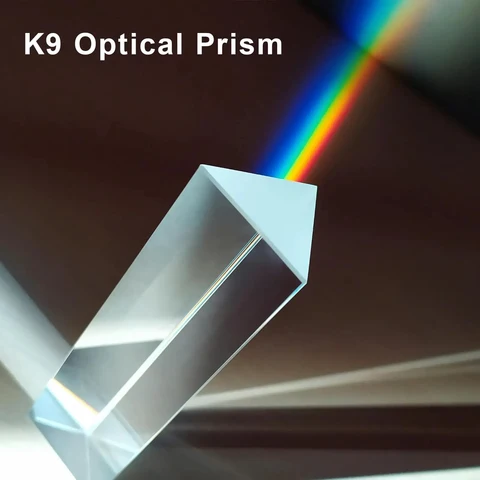
K9 is an optical glass grade — a barium crown glass originally formulated for lenses, prisms, and precision optics. Before it ever held whiskey, the same family of glass was shaped into camera lenses and laboratory prisms, where clarity and light-bending precision aren’t marketing words — they’re engineering requirements.
That origin is the whole story. Optical glass is specified by two numbers that tableware brands rarely mention:
- Light transmission — how much light passes cleanly through (~91% for well-made K9)
- Refractive index — how sharply the material bends light (K9 sits around 1.51, high for a lead-free glass)
Those two properties are exactly what you see when a cut K9 glass catches a lamp: bright transmission through the body, and hard, spectral flashes off the facets — real color separation, the same dispersion a prism produces.
The Honest Comparison: K9 vs. Lead Crystal vs. Ordinary Glass
| Attribute | K9 Optical Crystal (Cristamor) | Lead Crystal (Traditional) | Ordinary Glass (Soda-Lime) |
|---|---|---|---|
| Light Transmission | ~91% | 85–88% | ~90% (flat, low refraction) |
| Refraction / Brilliance | High — optical grade | High | Low |
| Lead Content | 0% | 24–32% | 0% |
| Mohs Hardness | ~6 | 5.5 | ~5.5 |
| Food Safe | Yes | Risk with acidic drinks | Yes |
| Care | Hand wash recommended | Hand wash only | Dishwasher safe |
Three rows deserve a closer look.
Lead: the old sparkle carried a hidden cost
Traditional lead crystal gets its brilliance from 24–32% lead oxide. It also slowly leaches that lead into whatever it holds — whiskey, with its alcohol and congeners, is an effective solvent. That’s why the industry moved away from it, and why “lead-free” is the first thing to check on any glass you drink from daily.
Refraction: where “crystal-look” glass gives itself away
Ordinary soda-lime glass is technically transparent — it transmits about as much raw light as K9. But it has a low refractive index and almost no dispersion, so light passes through flatly. A cut pattern in soda-lime glass looks like texture. The same pattern cut into K9 looks like light itself — because the material splits white light into color at every facet. That’s the prism effect, working in your hand.
Hardness: why hand-cut facets hold their edge
K9 sits at roughly Mohs 6 — a touch harder than lead crystal and noticeably harder than soda-lime. That hardness is what makes precise hand-cutting possible at all: a craftsman’s wheel can carve crisp, sharp-edged facets into K9 that would blur or chip in softer glass. It also means the facets resist the dulling and scratching that turn cheap “crystal” cloudy after a few months of ice and washing.
Then Why Is the Word “Crystal” on Cheap Glasses?
Because in most of the world, “crystal” is a marketing term, not a material spec. Depending on the market, a glass can be sold as “crystal” for containing a minimum percentage of metal oxides — or for no verifiable reason at all. “Crystal-style,” “crystalline,” and “crystal-cut look” mean, quite literally, ordinary glass shaped to imitate crystal.
The fix is simple: look past the word and ask what the material actually is. Optical-grade K9 is a specific, checkable answer. “Premium crystal” is not.
Why K9 and Hand-Cutting Belong Together
A material’s refraction only becomes visible through geometry. A flat K9 sheet looks like clean glass — the sparkle appears when facets are cut at angles that force light to bend and split. The harder and purer the material, the crisper those angles can be.
That’s the logic behind every Cristamor piece: K9 optical crystal for the optics, hand-cutting for the geometry. The wheel work turns a lens-grade material into something that throws rainbows across a dinner table — and the combination is why no two pieces are perfectly identical.
A Practical Note on Care
Harder doesn’t mean indestructible, and cut surfaces deserve respect. Hand wash with mild soap and a soft cloth, and the facets stay brilliant for decades. Dishwashers are safe for your everyday soda-lime tumbler — but they’re the fastest way to dull a hand-cut edge on any crystal, K9 included.
The Bottom Line
“Crystal” on a label means almost nothing. The questions that matter: Is it lead-free? Is it optically clear, or just see-through? Will a cut pattern in it actually play with light? K9 optical crystal answers all three — born in lenses, cut like jewelry, and poured like a toast.