
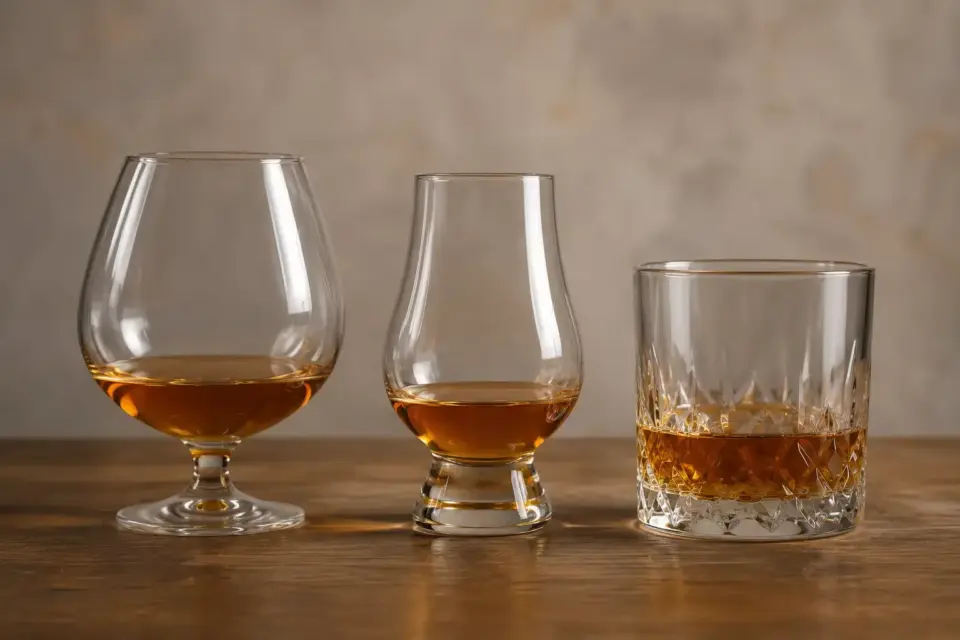
Two camps, one honest question
Ask whiskey drinkers which glass to use and you will hit two camps fast. One side insists the Glencairn is the only proper glass because it concentrates aroma. The other reaches for a heavy rocks glass because it feels better in the hand, handles ice without complaint, and turns a normal pour into a small ritual. Both camps are right about something — and an honest look at what each glass actually does settles the question faster than the arguments do.
What each glass is actually for
The Glencairn: a nosing instrument
The tulip shape is not decoration. A nosing glass directs ethanol away from your nose while concentrating the heavier aromatic compounds — caramel, fruit, spice — that make a whiskey interesting. Because most of what we call taste is smell, that concentrated aroma is the whole point: subtle notes that get lost in a wide-open tumbler show up clearly in a Glencairn. This is why tasting reviewers and communities treat it as the default for drinking whiskey neat.
The rocks glass: feel, ice, ritual
A rocks glass (old fashioned glass, lowball tumbler) is built for everything a delicate nosing glass is not: ice cubes, mixers, a solid weight in the hand. Its wider mouth lets sharp ethanol release rather than concentrate — which is exactly what many people want from a relaxed pour. For cocktails and on-the-rocks drinking, communities consistently treat it as the only sensible choice; a narrow Glencairn simply is not built to handle ice.
The honest caveat: can you actually taste the difference?
Here is where most guides stop short. Some drinkers pour the same whiskey into a rocks glass and a Glencairn side by side and honestly cannot tell a difference — and they find the Glencairn awkward to hold. That skepticism deserves respect rather than dismissal. What the aroma-focused side can say with confidence is narrower but real: the glass changes what reaches your nose, and nose is most of flavor. If you taste blind and notice nothing, a tumbler serves you fine. If you pick up distinct notes in a tulip glass that vanish in a tumbler, the nosing glass has earned its place on your shelf.
How real drinkers actually use both
Watch what experienced drinkers do rather than what they argue, and a pattern appears: a Glencairn for first tastes, a rocks glass for everything else. The first pour of a new bottle goes neat into a nosing glass, where it gets full attention. Everyday drinking drifts to a personal tumbler — often a custom engraved one — because it fits the hand and the habit. Bourbon drinkers add one more nuance: some switch to a rocks glass for barrel-proof pours, where the Glencairn’s concentrated delivery feels aggressive and the wider opening is more relaxed.
So which one should you use?
- You drink neat and care about tasting notes — a Glencairn-style nosing glass is the tool for the job.
- You drink on the rocks or make cocktails — a heavy-base rocks glass is the right call; ice needs the room.
- You are buying a gift — match the glass to how they drink first; a rocks drinker with a delicate nosing glass gets a gift that sits in a cabinet. Our whiskey glass gift guide walks through that decision.
- You cannot decide — that is not indecision, it is the correct answer. More on that below.
Why the real answer is: get both
Comparison guides converge on the same conclusion, and buyers agree — “whiskey glass set” draws about 4,400 US searches a month, and “custom rocks glass” roughly 590 (Google keyword data via YepAPI, September 2026). A nosing glass and a tumbler are not competitors; they cover different moments. The complete home setup is a proper tasting glass for the whiskies that deserve attention and a weighted, comfortable tumbler for casual pours, ice and guests. Lead-free crystal on both sides of the pairing keeps the shelf consistent — our guide to lead-free crystal whiskey glasses covers what to look for.
At Cristamor
We make lead-free crystal whiskey glasses in both shapes: tulip-style nosing glasses for the whiskies you want to study, and weighted rocks tumblers — available with permanent engraving — for the pours you actually live in. Browse the collection at cristamor.com and build the pairing that matches how you drink.
The bottom line
The Glencairn-versus-rocks debate only looks like a fight. The Glencairn is a tool for aroma; the rocks glass is a tool for living. Use the tulip when you are tasting, the tumbler when you are drinking, and let the two coexist on the same shelf — that is what the drinker who owns both already knows.
One housekeeping tip that applies to either glass: skip the dishwasher. Harsh detergent and heat cycles leave a cloudy film on fine glassware — our guide on how to clean crystal whiskey glasses keeps both shapes clear for years.