
Pour the same whiskey over ice, and it can taste like a completely different bottle. Some flavors step forward; others seem to vanish. That’s not your imagination — two separate processes kick in the moment ice hits the glass, and they pull in opposite directions. Understanding both is the key to knowing exactly how you like your dram.
Mechanism 1: Dilution Actually Opens Some Flavors
Counterintuitive but true: adding water to whiskey can make certain aromas stronger. A molecular study published in Scientific Reports found that dilution increases the chance that amphipathic compounds — molecules with both water-loving and water-fearing parts — gather at the liquid-air interface. The classic example is guaiacol, the smoky compound in peated malts: as the whiskey is diluted in the glass, guaiacol becomes more likely to escape the surface and reach your nose. In other words, a little water can push smoky, phenolic aromas up and out of the glass.
Mechanism 2: Cold Mutes Everything Else
Here’s the counterforce: ice doesn’t just dilute, it chills. And cold works against aroma in two ways. First, ethanol evaporation slows in a chilled glass — less vapor means less aroma reaching your nose. Second, your palate itself goes quiet: as one sommelier explained in Food & Wine, at around 59°F the “conducting channels” that carry flavor signals to your brain stop sending them as clearly, so you detect less of each flavor. Cold also numbs the receptors that register sweetness, bitterness and alcohol burn, and makes the whiskey feel thicker and less expressive on the palate.
The Tug-of-War: Why Ice Flattens What Water Would Open
Put the two mechanisms together and you get the paradox. Room-temperature water offers dilution without the chill — so it opens hydrophobic aromas while leaving volatility intact. Ice offers both at once: it re-weights the volatile balance and suppresses evaporation and numbs your palate. The result is a dram that tastes rounder and mellower but noticeably flatter — which is exactly why some drinkers find on-the-rocks whiskey “harder to drink” than neat even though the alcohol sting is gentler.
Ice Format Matters More Than You Think
If you drink on the rocks, the shape of your ice is the dial that controls how fast the tug-of-war plays out:
- Small cubes: lots of surface area relative to volume — they melt fast and over-dilute quickly, watering down the glass before you’re halfway through.
- Large cubes and spheres: less surface area relative to volume — spherical ice melts roughly 20-40% slower than traditional cubes, diluting at a much more controlled rate. This is the format for slow sippers who want chill and flavor retention.
- The zero-dilution trick: chill the glass in the freezer for 10 minutes before pouring — you get the cold without any meltwater at all.
Which Whiskeys Hold Up to Ice?
Community experience (and simple physics) points the same direction: higher-proof whiskeys stand up to dilution better. Barrel-proof bourbon retains more character over a large cube than a lower-proof pour, because there’s more flavor concentration to lose. If your bottle sits at the standard 40-43% ABV, neat or with a single large sphere is usually the safer way to keep the aromas you paid for. And if you’re tasting something for the first time, try it neat first — then add ice and see how the profile shifts. You’ll learn what dilution actually does to that whiskey.
The Glass Is Part of the Equation
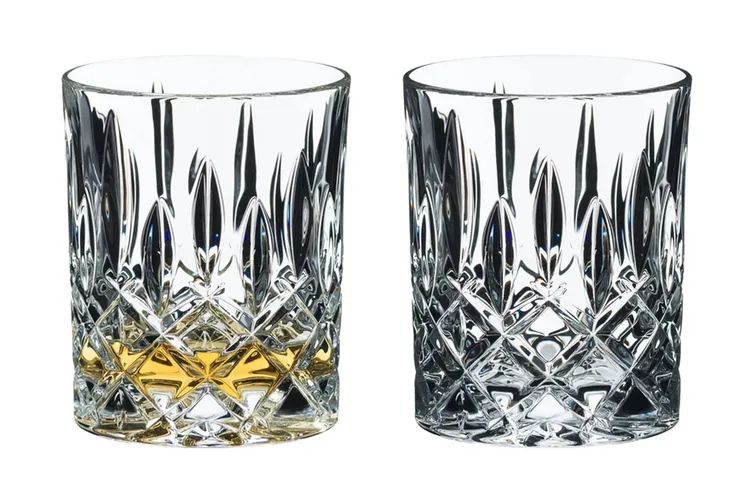
Ice changes the whiskey; the glass changes the experience. A wide rocks glass accommodates a large sphere comfortably and suits the slower, mellower on-the-rocks style. A narrow-rim tasting glass concentrates what aroma remains in a chilled pour — as we covered in why whiskey smells different in different glasses, rim geometry decides what reaches your nose. Pair the two right and even an iced pour stays expressive.
The Cristamor Take
There’s no wrong way to drink your whiskey — but there is a right glass for how you drink it. Cristamor’s hand-cut, lead-free crystal rocks glasses are sized and balanced for large-format ice: thick bases that slow melt contact, wide bowls that hold a 2.5-inch sphere, and clarity that shows the drink properly. For the aroma-first drinker, our tasting glass lineup keeps the narrow-rim precision that makes even a chilled dram worth nosing.
Building your at-home whiskey setup? Explore the Cristamor crystal whiskey glass collection — and if you’re weighing glass styles for different serving styles, our Glencairn vs. rocks glass guide breaks down which glass fits neat sipping versus on-the-rocks sessions.