
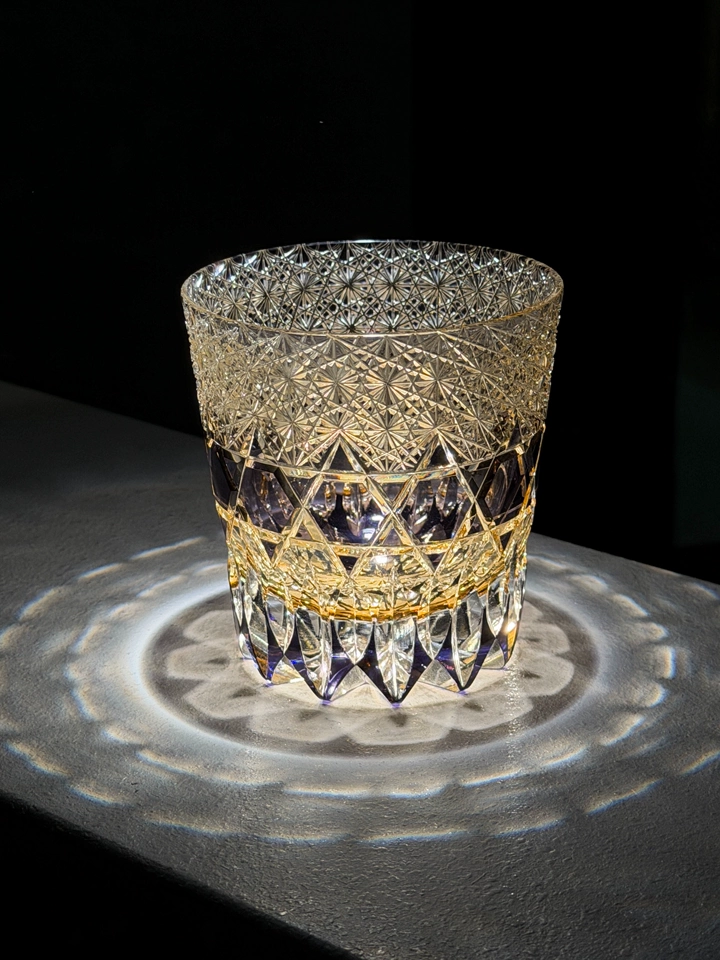
The Old Fashioned is the simplest whiskey cocktail to order and, surprisingly, one of the most demanding to serve properly. The glass isn’t a bystander — it has to hold a big ice cube, survive stirring and muddling, and still feel right in your hand for the next forty minutes. Get it wrong and the drink fights the vessel. Here’s how to pick the right one, without the marketing fog.
First, Decode the Names
Walk into any homeware store and you’ll see three labels on the same shelf: Old Fashioned glass, rocks glass, and lowball. They all refer to the same short, wide, heavy-bottomed tumbler — the cocktail predates the glass’s standardized name. What actually varies is size: a single rocks glass runs 8-10 oz and comfortably takes a 1.5-2 inch cube, while a double old fashioned glass runs roughly 10-14 oz and handles a double pour, a large sphere, or a drink with more mixer. If you’re buying one glass for the classic built-in-the-glass Old Fashioned, you’re shopping in the double range.
The Capacity Math Nobody Explains
Here’s the arithmetic that separates a good glass from a frustrating one. A standard Old Fashioned is about 2 oz of whiskey plus bitters, sugar and a splash of water; add a large cube or sphere and 3.5 oz of finished drink is typical. Recipe guides peg the ideal capacity at 9-12 oz — big enough that the rim never crowds your nose with the cube inside, small enough that the drink doesn’t vanish at the bottom. Cocktail-instruction thinking agrees: your 2 oz pour should sit around 30% of the glass height, and with ice the drink should come to roughly 40-60% — leaving slosh room to stir without launching bitters across the bar. A glass that’s too short, meanwhile, has a different problem: the cube smacks your nose when you tip it to sip.
Three Physical Requirements (Non-Negotiable)
Ask experienced home bartenders what actually matters and the answers converge on three things:
- Straight or slightly tapered sides — so the muddler and bar spoon reach the corners and the big cube sits flat instead of wedged.
- A heavy base — the Old Fashioned is built in the glass: muddling the sugar cube with bitters, stirring 20-30 rotations, setting the glass down on wood. A featherweight tumbler slides, tips and rings with every stir.
- A wide mouth — it takes the large-format ice, gives room to express an orange peel over the surface, and leaves space for the cherry without a toothpick Jenga act.
Notice what’s not on this list: a narrowing rim. That’s deliberate — and it’s the next point.
The Aroma Trade-Off: Why Open Top Is the Design, Not a Flaw
If you’ve read our guides on glass shape, you know narrow rims concentrate aroma. So why do Old Fashioned glasses do the opposite? Because the drink has changed. A cold, diluted, stirred cocktail releases its aromas differently than a warm neat pour — the open top lets those volatile notes escape gradually as you sip, which suits a drink you’ll nurse for half an hour. The wide mouth also keeps cheese of orange oils and cocktail aroma from concentrating into a ethanol-heavy blast at your nose. In short: the Old Fashioned glass is purpose-built for the cocktail, not a failure at nosing. That’s what your tasting glass is for.
How the Mass-Market Picks Compare
The major review outlets converge on recognizable names: Serious Eats named the Spiegelau Perfect Serve Double Old Fashioned its top cocktail glass, while Food & Wine’s 2026 testing praised Riedel’s rocks glasses as “the perfect size and shape for Old Fashioned-style cocktails” and tapped Libbey’s Heavy Base Rocks Glasses as best value. These are all sensible picks — machine-made, consistent, and widely available. What they don’t offer is craft: hand-cut patterns, the weight and optical depth of lead-free crystal, and a glass that looks like it belongs to the ritual rather than the bar rail.
What to Look for in a Crystal Old Fashioned Glass
- Capacity 9-12 oz — the sweet spot for cube + drink + slosh room.
- Thick, stable base — muddling and stirring need a glass that doesn’t wander; heavy bases also feel substantial in the hand.
- Wide mouth — takes a 2-2.5 inch sphere or cube and leaves aroma room above the liquid.
- Lead-free crystal — the sparkle and ring of crystal without the lead; safe for daily use and gift-giving.
- Hand-cut exterior — beyond looks, cut facets give a secure grip even when condensation forms.
The Cristamor Take
Our hand-cut, lead-free crystal rocks glasses were designed around exactly this spec: the capacity holds a large sphere plus a full build, the heavy base takes stirring without a wobble, and the wide mouth gives the orange peel room to work. The cut-crystal exterior isn’t decoration — it’s grip, refraction, and the weight of a glass that feels like the ritual it serves. For the Old Fashioned drinker who also keeps a tasting glass on the shelf, it’s the yin to the Glencairn’s yang.
Upgrading your Old Fashioned setup? Explore the Cristamor crystal rocks glass collection — and for the wider decision between styles, our rocks vs tasting glass comparison and thick-bottom buyer’s guide cover the rest of the reasoning.