
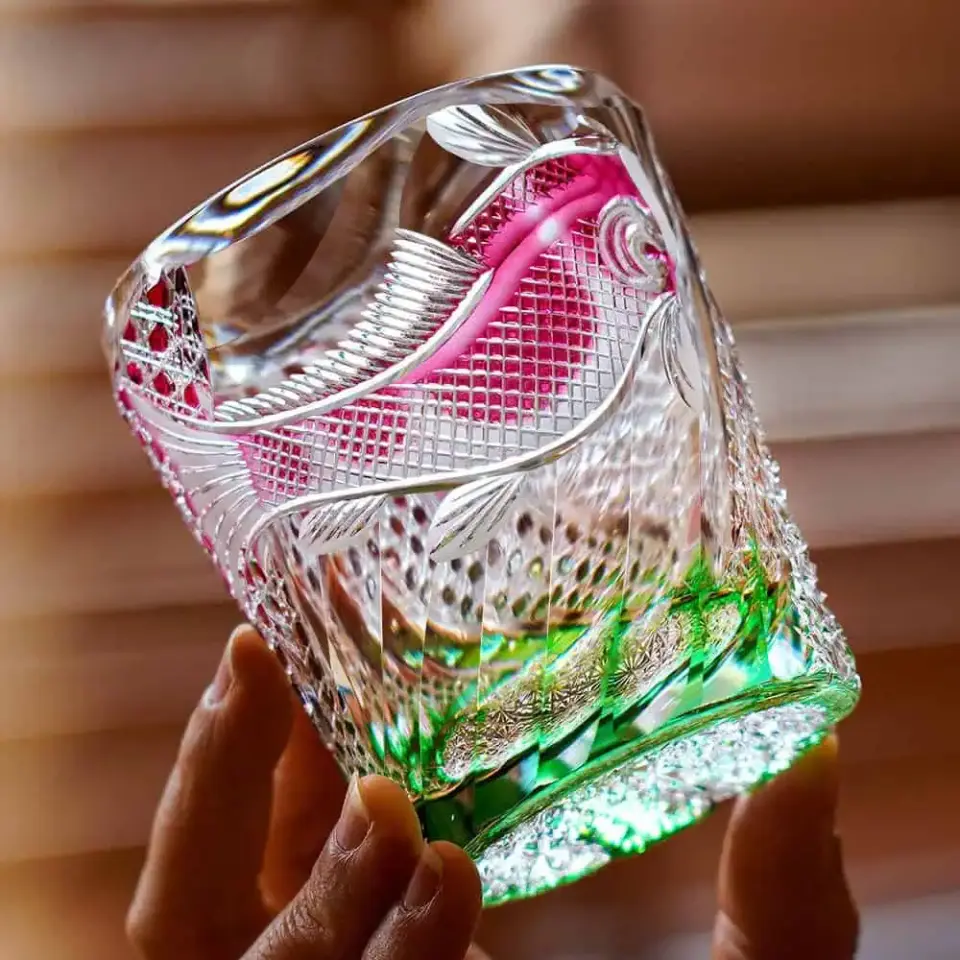
Why Do Some Whiskey Glasses Have Faceted Designs? Every Facet Has a Job
Run a finger down a cut crystal whiskey glass and the answer is right there under your fingertip: the facets are not decoration. Each flat, polished plane is carved into the glass — and each one earns its place with a practical job, from the way light moves through the drink to the way the glass sits in your hand.
Function 1: Light refraction — the amber show
Faceted planes act like tiny prisms. Seller guides for faceted crystal tumblers describe sharp geometric planes maximizing light interaction, bouncing ambient room light directly through the pour. On ordinary flat glass, whiskey looks the same from every angle; in a faceted cut crystal glass, highlights shift and the amber deepens as you turn it. It is the same effect that makes cut crystal sparkle — applied to your drink.
Function 2: Secure grip — especially with a heavy pour
Deep facets give the hand something to hold. Bar-focused cut crystal guides point out that deep facets provide a secure grip for a pour at the bar or tasting table — practical when the glass is a substantial 300-plus gram crystal piece with a full 8–10 oz pour. A smooth tumbler can slip; a faceted one does not.
Function 3: Fingerprint-free holding
Japanese crystal makers design the faceted base so the glass can be held without fingerprints on the bowl. Smudges on a curved bowl catch light and dull the look; holding the glass by its faceted lower section keeps the viewing zone clean. Function and presentation in the same detail.
Function 4: The rim — thin where it matters
Cut crystal can be worked thin while keeping strength, and guides consistently note that a thinner rim means you taste the whiskey rather than the glass. Faceting allows the body to carry visual weight while the rim stays refined — a balance molded glass struggles to achieve.
And the taste question, honestly
Multi-source guides converge on the same careful framing: glass shape and rim thickness influence how whisky delivers to the palate, and crystal’s clarity makes color evaluation easier — but no glass changes the liquid itself. Facets improve the experience; the whiskey does the rest.
Where Cristamor fits
Cristamor’s hand-cut glasses — including the Cobalt Ember Lattice, Aqua Radiant Starburst, and Handcrafted Tanma with Wooden Box — are built facet-first: every cut plane is placed for light, grip, or feel in lead-free K9 crystal. If you are choosing between faceted and smooth, our hand-cut vs machine-cut guide covers the trade-offs in detail.
The takeaway
Facets exist because they do something: bend light, steady the grip, keep the bowl clean, thin the rim. A faceted whiskey glass is engineering you can see — and feel.