
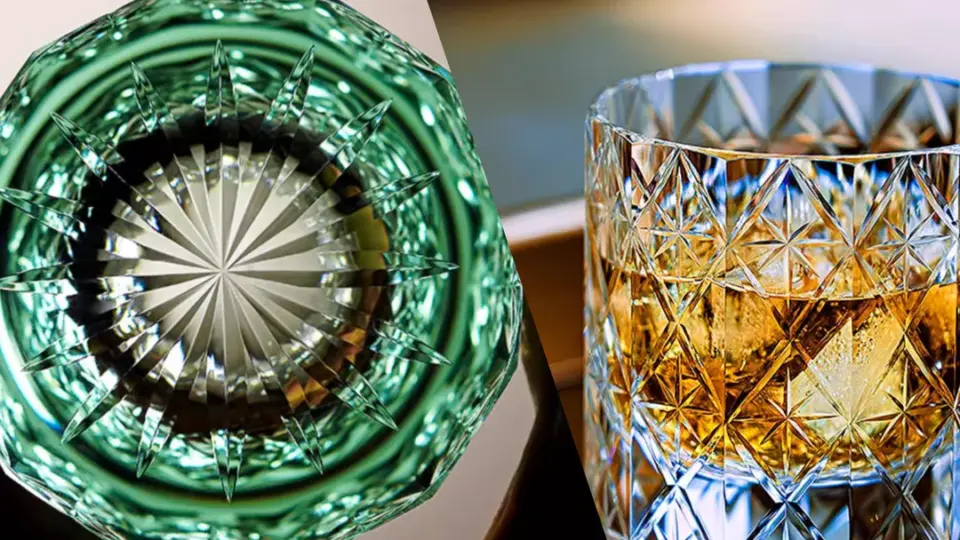
Two crystal whiskey glasses can look almost identical in a product photo — same sparkle, same cut pattern, same promise of “premium” — and yet one was shaped by an artisan at a cutting wheel and the other came out of a mold. That difference matters for price, for durability, and for how the glass feels in your hand. This guide compares hand-cut and machine-cut crystal honestly: what each one actually is, what each does better, and how to tell them apart before you spend your money.
What “hand-cut” actually means
Genuine cut crystal is defined by its method: patterns are applied by hand, guiding the glass against powered cutting wheels. That’s the line collectors and appraisers use — and it comes with a practical fingerprint. Cut glass and crystal carry no mold marks or seams, because nothing was pressed into a form. If you can find a seam line or a molded texture, the piece was machine-pressed, not hand-cut.
Why the material makes hand-cutting possible
There’s a reason the fancy cutting happens on crystal and not on ordinary glass. Crystal’s mineral content keeps the material malleable enough to take smooth, detailed hand-cut patterns without sacrificing durability. Ordinary soda-lime glass hardens quickly during production — surface cuts on glass tend to end up sharp, rigid and brittle. So when you see deep, smooth, intricate facets on a whiskey glass, that’s crystal doing something glass structurally struggles with.
The honest case for machine-made
Hand-cut isn’t automatically “better” — machine production wins on three fronts that matter in real life:
- Consistency. Machine-made glassware is uniform and durable, which is exactly why tasting professionals use it: an identical glass ensures a consistent sip when comparing drinks.
- Toughness. A tempered machine-made tumbler will survive years of dishwashing and the occasional counter drop that would end a fine-rimmed crystal piece.
- Scale and price. Automated lines produce unmatched uniformity across tens of thousands of identical units — which is also why machine-made costs far less.
If your priority is an everyday glass that takes abuse without complaint, machine-made is a rational choice, not a compromise.
What hand-cut crystal offers in return
What you pay for with hand-cut is character that production lines can’t replicate. Artisan-carved facets catch light differently across every surface, the piece carries more weight and a better ring, and — because each glass is individually worked — no two are exactly alike. At the top end of the craft, Japanese Edo Kiriko whiskey glasses are typically marketed in the $150–$400+ range, with the pricing framed around a multi-step artisan process: the piece is treated as an heirloom, not a commodity. Buyers who choose hand-cut consistently describe the heft and sparkle as worth it for glasses they’ll keep for years.
How to verify a “hand-cut” claim before you buy
You don’t need to be an appraiser to run basic checks. Before buying:
- Look for mold seams. Cut crystal has none; pressed glass usually does.
- Twist it in the light. True crystal acts as a prism — you should see rainbow color dispersion as light passes through the facets. Plain glass shows none.
- Tap the rim. Crystal rings with a high-pitched chime; ordinary glass gives a dull thud.
- Feel the weight. Crystal is typically heavier than it looks, with thinner walls.
If a seller’s “hand-cut” glass fails the seam test, you have your answer.
So which one should you buy?
Both categories are legitimate — the right answer depends on the job:
- Choose hand-cut crystal for gifts, celebrations and slow pours where the glass is part of the experience — and for pieces you want to keep and hand down.
- Choose machine-made for high-volume everyday drinking, outdoor use, or households where glasses meet the dishwasher more often than guests.
If you’re weighing overall glass types rather than cutting methods, our whiskey glass types guide and K9 crystal vs lead-free crystal breakdown cover the rest of the decision tree.
Where Cristamor stands
Cristamor whiskey glasses are hand-cut lead-free crystal: artisan-cut facets with real weight and ring, made from modern stable-oxide crystal so you get the handmade character without the lead question. Whether you’re choosing a single statement glass or a gift set, our single glass vs gift set comparison and bourbon gift glass guide help you match the budget to the moment.
Conclusion
Hand-cut and machine-cut crystal aren’t rivals so much as tools for different jobs. Machine-made wins on consistency, toughness and price; hand-cut wins on sparkle, weight, ring and the simple fact that a person made it. Verify with the seam, prism, chime and weight checks, buy hand-cut when the glass is part of the moment — and it will be worth it every time you pour.
Ready to feel the difference? Explore Cristamor’s hand-cut lead-free crystal collection at cristamor.com.