
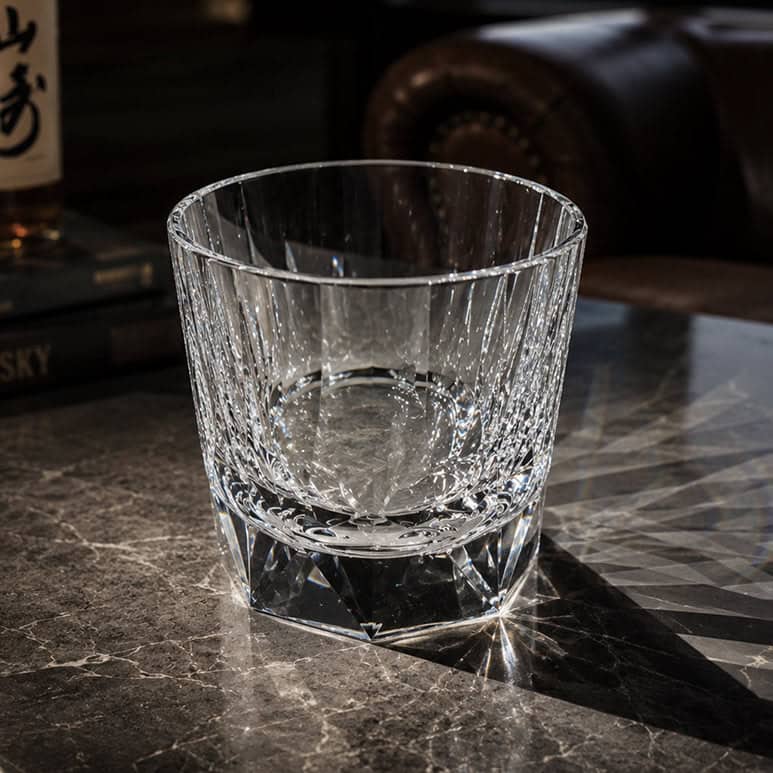
One beautiful glass or a whole box of “stuff”? It is the most common whiskey-gift deadlock of the season. Budget gift sets promise completeness — four glasses, whiskey stones, a wooden box, all under $30. A single premium hand-cut crystal glass costs as much as the entire kit. The honest answer: neither is automatically the better gift. They optimize for different things, and the liquid does not taste “better” in either one. Here is what your money actually buys in each — and a decision framework by recipient.
First, the honest part: the whiskey does not care
Ask any serious whiskey community and you will hear the same consensus: the glass changes the experience, not the liquid. Whiskey at 40–50% ABV will overwhelm your nose in a tumbler and open up in a narrower rimmed glass — that is geometry, not magic. Budget sets and premium glasses alike are sold with aroma-and-flavor storytelling, and some of that marketing overreaches. What genuinely differs between a $17 four-piece set and a $50+ hand-cut crystal glass is material quality, craft, and the feeling the object gives the person holding it. Buy for those, and you will not be disappointed.
What a budget gift set actually optimizes
- Completeness. A box that opens like a presentation: multiple glasses, chilling stones, sometimes coasters or a wooden case. As a gesture, it reads generous.
- Price predictability. Under $30 for the whole kit — the safest spend for coworkers, party exchanges, or a recipient whose taste you do not know.
- Low stakes. If one glass chips in a dishwasher a year later, nobody mourns it. Mass-produced soda-lime sets are consumables in the nicest sense.
What you give up: material transparency. Most budget sets do not state crystal composition or lead content, glass walls are thick and uneven, and the extras (stones, coasters) are where the margin lives. It is a gift that looks complete and costs little — nothing more, and it does not pretend to be.
What a single premium glass actually buys
- Aroma geometry. A tuned rim concentrates aromas at the nose; thinner, even walls put less glass between you and the whiskey. This is the functional case for premium — it is real, and it is about shape and finish, not price tags.
- Lead-free crystal, stated openly. Reputable premium makers say “lead-free crystal” out loud and in writing. If a seller cannot tell you what the glass is made of, that silence is the product.
- Visible craft. Hand-cut patterns catch light in ways molded glass cannot fake. On a bar shelf, one hand-cut crystal glass stands out more than four identical molded tumblers ever will.
- Longevity and attachment. The r/BuyItForLife pattern is consistent: people keep one special glass for decades and hand it down. Nobody says that about a $17 set.
- Gifting weight. Engraving, a wooden gift box, a certificate — a single glass can carry a whole gift occasion by itself.
The decision framework: buy by recipient
- The whisHkey serious hobbyist (owns Glencairns, talks about nosing): one premium glass, ideally with a distinctive cut or a shape they do not already own. A budget set will go straight to the back of the cupboard.
- The casual sipper (drinks whiskey socially, ice optional): a budget set is genuinely fine — and honest. They get multiple glasses and will actually use them.
- The “has everything” father-in-law / boss / client: one hand-cut crystal glass with engraving. The personalization is the gift; the set would feel like an office raffle prize.
- The couple / housewarming: this is the one case where a matched premium pair beats both extremes — two hand-cut glasses, engraved, in one box. Gifting weight of a set, quality of a single.
- Secret Santa / office exchange / unknown tastes: budget set, no guilt. The completeness is the point at this budget.
Where Cristamor sits in this picture
Cristamor’s hand-cut lead-free crystal glasses occupy the deliberate premium slot this framework points to: K9 optical crystal, hand-cut patterns (from the cobalt lattice of the Cobalt Ember Lattice to the Kyoto Collection), stated materials, free engraving, and gift-ready packaging with a wooden box on selected designs — a single glass that reads as a complete gift. At $96–$139 for most of the signature line, one Cristamor glass costs about what a mid-tier set of four does; the difference is that every dollar above the commodity kit is spent on material, craft, and personalization rather than on bundling more accessories.
The bottom line
Budget sets optimize completeness; a premium single optimizes experience and permanence. The whiskey tastes the same from both — the gift does not. Match the spend to the recipient: sets for quantity and low stakes, one exceptional glass for people who will notice, keep, and use it for years.