
- by admin
- 17.07.2026
- optical-grade crystal glass
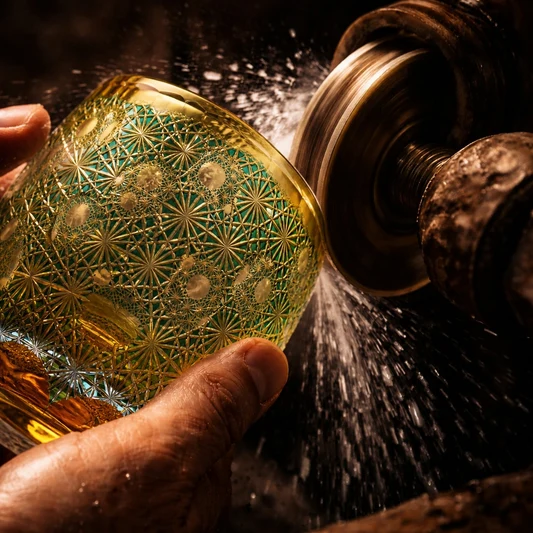
Hand-cut crystal is more than a craft—it’s a dialogue between human hands and light itself. The story begins in 17th-century Europe, where glassmakers discovered that precise cuts on a crystal surface could transform ordinary glass into a prism of infinite reflections.
From European Courts to Modern Studios
The technique was born in the courts of Bohemia and refined by Japanese Edo Kiriko masters. Each tradition brought its own philosophy: European cuts favored deep, geometric patterns that maximized light refraction, while Japanese artisans developed softer, nature-inspired motifs that seemed to breathe with the glass.
At Cristamor, we honor both traditions. Our artisans study the classical patterns—diamond cuts, star bursts, lattice work—before developing their own signature styles. Every glass we produce carries this 300-year legacy, translated through contemporary design.
Why Hand-Cutting Still Matters
In an age of machine-made everything, hand-cutting remains irreplaceable for one simple reason: no machine can replicate the subtle variations that make each piece unique. The pressure of a human hand, the angle of a grinding wheel, the split-second decision to deepen a cut—these are things algorithms cannot simulate.
When you hold a hand-cut crystal glass up to the light, you’re not just seeing refraction. You’re seeing the imprint of a craftsperson’s decisions, accumulated over hours of focused work. That’s why every Cristamor piece comes with our promise: cut by hand, never by machine.