
Standing in front of a whiskey aisle is easy compared to standing in front of a glassware shelf. Rocks glass, Glencairn, copita, tulip, highball — and every product page claims its shape “unlocks” your whiskey. Here is the good news: the buying decision is simpler than the marketing suggests. Across enthusiast communities, distillery guides and 2025–2026 editorial testing, one consistent recommendation emerges — and it maps neatly to the whiskey you drink and the way you serve it. This guide walks through each whiskey type, matches it to the right glass, and ends with a starter kit you can buy once and use for years.
Does the Whiskey Type Really Change the Glass You Need?
Short answer: the whiskey type changes the emphasis, not the fundamental physics. Bourbon, single-malt scotch, rye, Irish and Japanese whiskies differ in grain recipe, proof and flavor intensity — and those differences shift how much aroma concentration versus openness you want from the rim. Glass guides disagree on whether bourbon and scotch need “different” glasses, but look closer and the disagreement is mostly about emphasis, not category. A narrow, tulip-narrowed rim concentrates delicate aromas and keeps ethanol vapor away from your nose; a wide opening does the opposite. Every whiskey style benefits from the first when sipped neat, and welcomes the second when ice or mixers enter the picture.
That is why mainstream buying advice has converged on a two-glass answer rather than a whiskey-by-whiskey shopping list. The type you drink decides which glass you reach for tonight — not which collection you need to buy.
The Tasting Glass: One Shape That Serves Nearly Every Whiskey Type
If you sip whiskey neat — bourbon, single-malt scotch, rye, Irish or Japanese — a tulip-shaped tasting glass is the tool the whiskey world agrees on. The Glencairn-style glass in particular has become the community default: it is the glass you will see at official tastings, in distillery visitor centers and across enthusiast forums, prized for concentrating aromas while taming the alcohol sting. Its narrow rim gathers the light, fruity compounds toward your nose and lets the harsher ethanol vapors slip past the edge — which matters whether you are nosing a sherried malt or a high-rye bourbon.
Bourbon
Bourbon’s sweet, oak-driven profile is generous with aroma, and a tulip nosing glass concentrates caramel, vanilla and char notes beautifully. For everyday bourbon on the rocks, the rocks glass takes over — see below.
Single-malt Scotch (including peaty and cask-strength bottles)
Scotch is where the tasting glass earns its keep, especially for peaty or cask-strength bottlings. The narrowing rim lets phenolic aromas arrive in layers instead of one medicinal blast, and keeps the considerable ethanol heat of cask-strength pours from overwhelming your nose. Collectors consistently report that a proper tasting glass is what makes expensive bottles make sense.
Rye
Rye’s spicy, assertive character behaves like bourbon in the glass: tulip for neat sipping and aroma-hunting, rocks glass when you want ice. The spice reads cleaner when the ethanol is kept in check.
Irish and Japanese whiskies
Both styles span the full range — light sippers, premium malts, and the iconic highball serve. Irish whiskey’s smoothness shines in a tulip glass neat, while Japanese whisky culture made the highball (whiskey over ice with sparkling water in a tall glass) a ritual of its own. If you drink highballs, that is the one case where a third glass — tall and narrow — genuinely earns its shelf space.
The Rocks Glass: Ice, Cocktails and Relaxed Pours
The wide-mouthed, heavy-based rocks (old-fashioned) tumbler is not a lesser tasting glass — it is a different tool for a different ritual. Its large opening and sturdy build exist for big ice cubes, generous swirling room and casual sipping, and it is the standard for whiskey cocktails like the Old Fashioned. Trying to fit an ice sphere into a tulip glass is a losing game; the shapes simply serve different moments. Households that drink whiskey both ways — neat tastings and iced evening pours — genuinely need both.
Taming the Burn: Glass Choice for High-Proof Whiskey
New whiskey drinkers routinely cite harsh burn as the reason they give up on neat pours — and glassware is part of the fix. A narrow rim keeps ethanol vapor from marching straight into your nose; pairing that with proper technique (short sniffs, nose slightly above the rim, pauses between sniffs) transforms how high-proof whiskey smells and tastes. Specialty shapes with flared, burn-diverting rims take this engineering a step further and are often suggested to burn-sensitive drinkers. No glass eliminates the heat of cask-strength whiskey — but the right shape plus the right technique gets you the aroma without the wince.
The Two-Glass Starter Kit (and the Smart Upgrade Path)
Almost every credible beginner guide lands on the same first purchase:
- One tulip/Glencairn-style tasting glass — for neat pours, nosing and comparing bottles.
- One solid rocks glass with a thick base — for ice, cocktails and easy evenings.
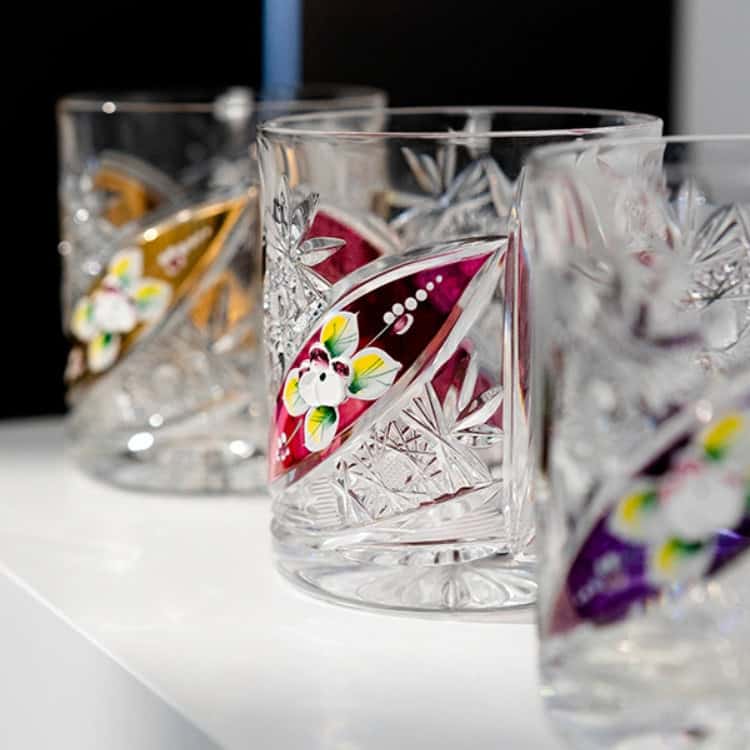
Optionally, add a tall highball glass if Japanese-style serves are your thing. That is the entire beginner decision — and it is exactly the logic behind Cristamor’s The Tasting Flight, which pairs a dedicated nosing glass and a Glencairn-style glass with a hand-cut crystal rocks tumbler in one collection, so the whole “which glass for which whiskey” question is answered in one box.
When you upgrade, material is where the difference lives. Cristamor’s glasses are hand-cut from lead-free optical-grade K9 crystal, chosen for exceptional clarity, ring and weight — the kind of glass that shows whiskey’s true color and makes the ritual feel earned. For the material deep-dive, see what makes K9 optical crystal different and our K9 vs. lead-free crystal comparison; and if you are buying cut crystal anywhere, our guide to spotting real hand-cut crystal will save you from machine-pressed imitations.
For the ice side of the pairing, a substantial hand-cut tumbler like the Amber Fuji Wave hand-cut crystal tumbler anchors iced pours, while the full Cristamor shop covers single glasses, gift sets and complete bar collections.
Whiskey Glass Selection Cheat Sheet
- Bourbon neat: tulip nosing glass · bourbon with ice: rocks glass
- Single-malt scotch (incl. peaty/cask-strength): tulip nosing glass, always
- Rye: tulip for neat, rocks for ice — same rule as bourbon
- Irish whiskey: tulip for neat sipping; rocks for casual long pours
- Japanese whisky: tulip for neat; tall highball glass for the classic highball
- Cocktails (Old Fashioned & co.): rocks glass, every time
- First purchase: one tasting glass + one rocks glass — done
Frequently Asked Questions
Do bourbon and scotch need different glasses?
No dedicated bourbon or scotch glass is required — the same tulip tasting glass and rocks glass cover both. The whiskey type changes which glass you reach for, not which ones you own.
Is a Glencairn-style glass worth it for beginners?
Yes — it is the community default for neat whiskey precisely because it concentrates aroma while softening the alcohol sting, and entry-level options are inexpensive.
What glass do I use for a whiskey highball?
A tall, narrow highball glass — the traditional serve for Japanese-style whiskey and soda, and the one case where a third shape genuinely adds value.
Can I taste whiskey in a rocks glass?
You can, but the wide opening lets delicate aromas escape and delivers more ethanol vapor — fine for casual sipping, suboptimal for evaluating a whiskey’s nose.
Conclusion: Match the Glass to the Whiskey Moment
Choosing whiskey glassware is not about owning a glass per whiskey — it is about matching the shape to the serve. Tulip for tasting, rocks for ice, highball for long drinks. Start with those two, upgrade the material when you are ready, and every bottle you own will show up the way its maker intended.
Ready to cover every serve in one decision? Explore The Tasting Flight and the Cristamor gift collections — hand-cut, lead-free crystal built for the way you actually drink.