
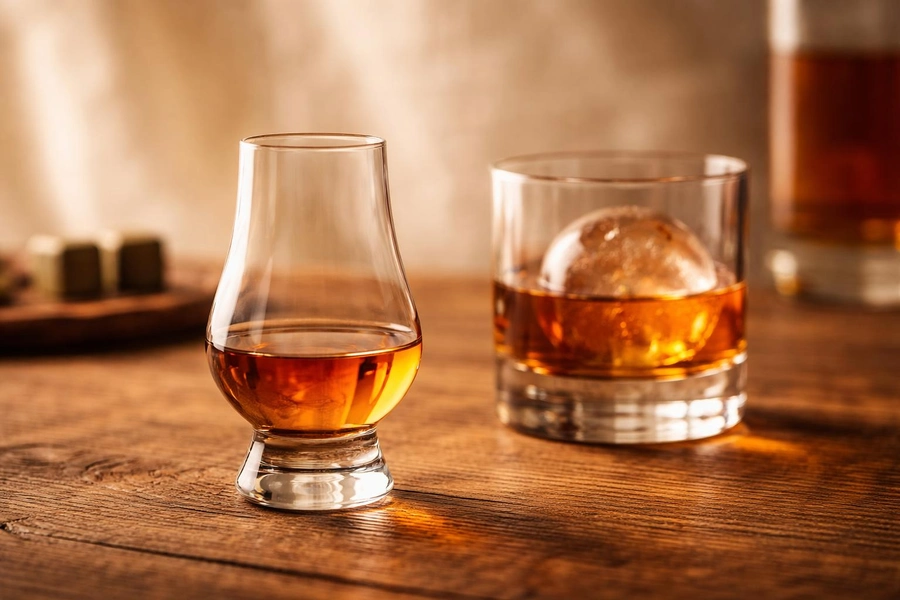
Walk into any whiskey conversation and you’ll find two camps: the Glencairn faithful who nose every pour, and the tumbler loyalists who like a heavy glass in hand. Both are right — for different styles of drinking. This guide gives you a simple way to match the glass to how you actually drink whiskey, explains why the shapes behave differently, and helps you pick the right format when you’re buying for yourself or as a gift.
The Two-Axis Rule: Pour Type and Spirit Type
Across tasting guides and whiskey communities, the same two questions decide which glass you should reach for:
- How do you pour? Neat sipping rewards a narrowed rim that gathers aromas toward your nose. Whiskey on the rocks, or mixed drinks, needs the wide mouth and solid base of a tumbler to accommodate large cubes, spheres, or crushed ice.
- What do you pour? For Scotch and single malts tasted carefully, the tulip shape is the enthusiast standard. For bourbon, high-proof pours, Old Fashioneds, and porch drinking, the rocks glass is the everyday workhorse — stable, easy to hold, and built for ice and stirred drinks.
If your answer to both questions is “it depends on the night,” that’s not indecision — it’s the honest answer. Whiskey writers increasingly say the same: most people who drink across styles eventually own both, because the two glasses are built for different nights.
Why the Glencairn Shape Concentrates Aroma
The Glencairn’s tulip bowl is not decoration. Its wide body gives the whiskey room to breathe, then tapers to a narrowed rim that concentrates volatile aromatic compounds as you nose the glass — which is why tasting-focused sources describe tulip glasses as making scents much easier to detect than a wide-open tumbler. The shaped rim also encourages the small, careful sips that tasting rewards.
One honest caveat: that same concentration can work against you. With higher-proof whiskey, a tightly focused rim can funnel ethanol burn straight into your nose and mask the aromas underneath — a documented trade-off that has led some glassmakers to design wider-nosed alternatives. If a dram stings rather than sings, back off, let it sit a minute, or try a slightly wider glass. Your nose will tell you.
What the Tumbler Does Better
The tumbler’s wide mouth lets aromas drift gently rather than concentrating them — a more relaxed, laid-back experience. That’s exactly right for drinking styles where the whiskey is social: on the rocks, in an Old Fashioned, or with a splash of water on a weeknight. The heavy base adds stability (harder to knock over on a crowded table) and the satisfying weight that makes a cut-crystal tumbler feel like an occasion in itself.
For spirit-forward pours, a hand-cut tumbler built for aroma and grip is the natural pick.
There’s a tradition argument, too: long before tulip tasting glasses went mainstream, the tumbler was the default whiskey glass — and plenty of longtime drinkers still see it that way. If your whiskey life is more porch than panel tasting, the tumbler isn’t a compromise; it’s the correct tool.
Quick Comparison
| Factor | Glencairn / Tulip | Rocks Tumbler |
|---|---|---|
| Aroma delivery | Concentrated at the rim — best for nosing | Open and gentle — relaxed sipping |
| Best pour | Neat, small pours, side-by-side tasting | On the rocks, mixed drinks, generous pours |
| Best spirits | Scotch, single malts, careful tasting | Bourbon, high-proof, cocktails |
| Ice and mixers | Not practical | Purpose-built for it |
| Stability | Stemless but top-heavy when filled | Heavy base, very stable |
| Feel in hand | Delicate, ritual | Solid, substantial |
Which Should You Buy First?
- You drink neat and like comparing bottles: start with Glencairns. In 2026 roundups the official Glencairn remains the default tasting glass — its gift-boxed sets and trade packs are widely available, and one roundup of crystal whiskey glasses calls it the first recommendation for anyone serious about single malts.
- You drink on the rocks, host, or mix cocktails: start with a quality tumbler set — ideally lead-free crystal with real weight. Reviewers consistently praise faceted crystal tumblers for the heft and light refraction that make an everyday pour feel premium.
- You do both: buy both — a tasting glass for quiet pours, a tumbler for company and ice. Enthusiast forums reach the same conclusion year after year: the glasses aren’t rivals, they’re a division of labor.
Gifting: Match the Glass to the Drinker
For gifts, the drinking-style rule matters even more — you’re choosing for someone else’s habits. A neat-drinking Scotch fan will genuinely use a tasting glass; a rocks-and-cigar person will reach for a weighted tumbler far more often. Premium gifting covers both formats: Glencairn itself sells cut-crystal tumbler presentation sets alongside its famous tasting glass, and 2026 gift guides recommend lead-free crystal in either shape for clarity and durability.
Cristamor’s hand-cut crystal whiskey glasses sit squarely in the tumbler lane — heavy sham, faceted cuts, made to be used daily and personalizable for milestone gifts. If the person you’re buying for is a rocks drinker, that’s your format; pair it with our guide to the best whiskey glass for men for shape-by-shape detail. For the materials side of the decision, our new optical crystal vs lead crystal guide covers the serving-vs-storing lead distinction every gift buyer should know.
The Bottom Line
Neither glass wins — the drinking style does. Neat, aromatic, comparative tasting rewards the Glencairn’s narrowed rim. Ice, cocktails, and casual pours reward the tumbler’s open mouth and heavy base. Choose by how you (or your gift recipient) actually drink, and if you’re honest, that answer probably includes both. Browse the Cristamor collection for hand-cut lead-free crystal tumblers built for daily rituals and engraved gifting — and for long-term spirit storage, see our lead-free crystal decanter buyer’s guide.