
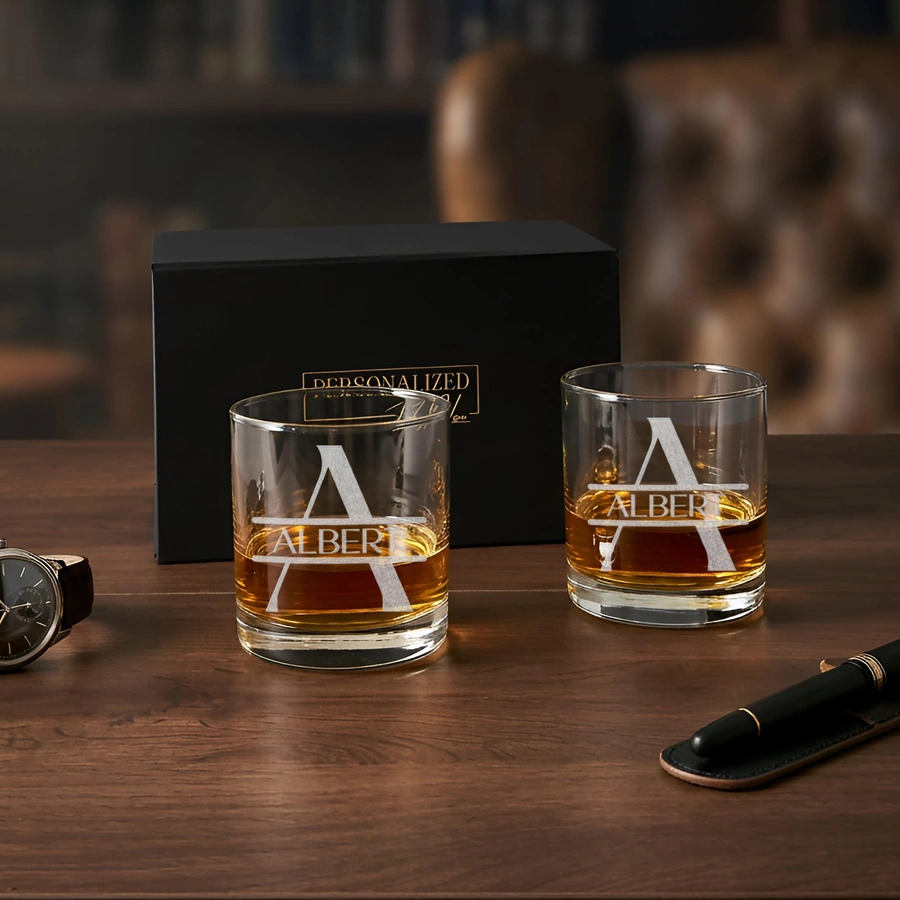
An engraved whiskey glass is one of the rare gifts that gets better with use. The right glass — with the right engraving, on the right material — leaves the gift box and lives on the bar cart for years. The wrong one ends up in a cabinet. This guide walks through the three questions that decide which one you end up with: what’s the occasion, which engraving method should you order, and what should the glass itself be made of.
Start With the Occasion: Three Gift Paths
Personalized whiskey glasses serve three distinct gift moments, and each one shapes what you should order:
- Wedding parties. The groomsmen gift is the classic — and the most established. Specialized retailers sell role-specific designs (Best Man, Father of the Bride, Groom) that pair each groomsman’s name and the wedding date with his role in the day. A personalized rocks glass photographs well at the bachelor party and stays in service long after the wedding.
- Corporate and client gifts. Engraved whiskey glasses with a company logo are a staple of client appreciation and employee recognition — premium-feeling, personal, and genuinely useful. Bulk engravers typically add per-item personalization for a small surcharge (one vendor charges about a dollar per glass to engrave a different name on each piece), which turns a logo gift into something individual.
- Personal collections. Whiskey drinkers commission engraved glasses for themselves too — a monogram, a club logo for a tasting group, or artwork from an independent engraver. Enthusiast communities consistently report these become the glasses they reach for first.
Engraving Methods: Laser vs Deep Sand-Carve
This is where most buyers get lost, so here’s the honest version. There are two mainstream methods, and both are permanent — but they produce visibly different results:
Laser engraving marks the glass surface with a focused beam. It’s permanent — the design can’t be washed off or worn away, and quality laser work is dishwasher safe. Its strengths are fine, consistent detail and efficient production, which is why it’s the default for bulk orders, logos, and text personalization. Its limitation is depth: laser marks sit at the surface, so the result is a crisp but visually light frosted marking.
Sand carving (sandblasting) blasts the design deep into the glass through a stencil, creating a dimensional, carved look you can feel with a fingertip. Industry suppliers generally recommend it for glass and crystal precisely because of that depth and presence. The trade-offs are cost and production time — which is why premium gift pieces and awards use it. A related technique, rotary engraving with a diamond tip, cuts deep lines but struggles with large filled areas of a design.
Which should you order? For wedding parties, corporate runs, and text-heavy personalization, laser delivers permanence at a friendly price. For a single milestone gift where you want the engraving to have real presence in the hand — monograms, crests, substantial artwork — deep sand-carving on quality crystal is worth the premium. Reputable vendors now offer both at different price points, so ask which method your order uses.
The Material Matters More Than You Think
Engraving quality is limited by what it’s engraved on. Engravers themselves point out that inexpensive glasses are usually soda-lime glass — softer, thinner, and less satisfying to hold. Better substrates change the outcome:
- Crystal takes engraving better. The heavier, clearer material gives both laser and sand-carved work more visual contrast and a more substantial feel in the hand.
- Lead-free crystal is the modern standard. It matches traditional crystal’s clarity and weight without lead — the same reason it dominates premium glassware and gift sets.
- Quality engraving survives daily life. Permanent engraving on a quality glass handles dishwasher cycles — which means the gift actually gets used instead of babied in a display cabinet.
If you’re choosing between two similarly priced engraved glasses, the one made from heavier, clearer crystal will almost always be the better keepsake. Our guide to optical crystal vs lead crystal covers the material science in depth.
Personalization Depth: From One Name to Per-Piece Uniqueness
The best engravers offer layers of personalization, and knowing the options helps you order something that feels considered rather than templated:
- Per-item names and initials — so every groomsman or client gets his own glass, not eight identical ones.
- Roles and dates — “Best Man,” “Father of the Groom,” or your wedding date turn a glass into a record of the day.
- Logos and artwork — company marks for corporate gifts, club crests for tasting groups.
- Photo etching — some vendors can etch a photograph into the glass, making a true keepsake.
- Design previews — quality engravers let you see and approve your design before production, which matters for curved glass where a logo can distort.
Order-Timing Rules That Save Gifts
One operational rule dominates buyer complaints, so treat it as law: once engraving starts, the order usually cannot be changed or cancelled. Personalization is custom production — your design goes to a stencil or machine file and cutting begins. Before you submit:
- Confirm the spelling of every name, the date format, and each person’s role.
- Use the design preview if the vendor offers one — check how the text sits on the curved surface.
- Order early enough for production time, and ask about rush options if the event is close.
- Check the satisfaction guarantee — established engravers typically back custom work.
The Cristamor Take
Cristamor’s hand-cut, lead-free crystal whiskey glasses are made for exactly this use: substantial weight, faceted cuts that catch light, and personalization for weddings, milestones, and corporate appreciation. For the groomsmen route, pair them with our guide to the best whiskey glass for men; for the rocks drinker on your list, see how formats compare in Glencairn vs whiskey tumbler. If your gift list includes someone who decants at home, our lead-free crystal decanter buyer’s guide completes the bar setup.
The bottom line: a great engraved whiskey glass is the combination of a real occasion, the right engraving method for your budget, and a substrate worth engraving. Get those three right and the glass leaves the gift box — permanently. Browse the Cristamor collection to start with a glass worth the engraving.