
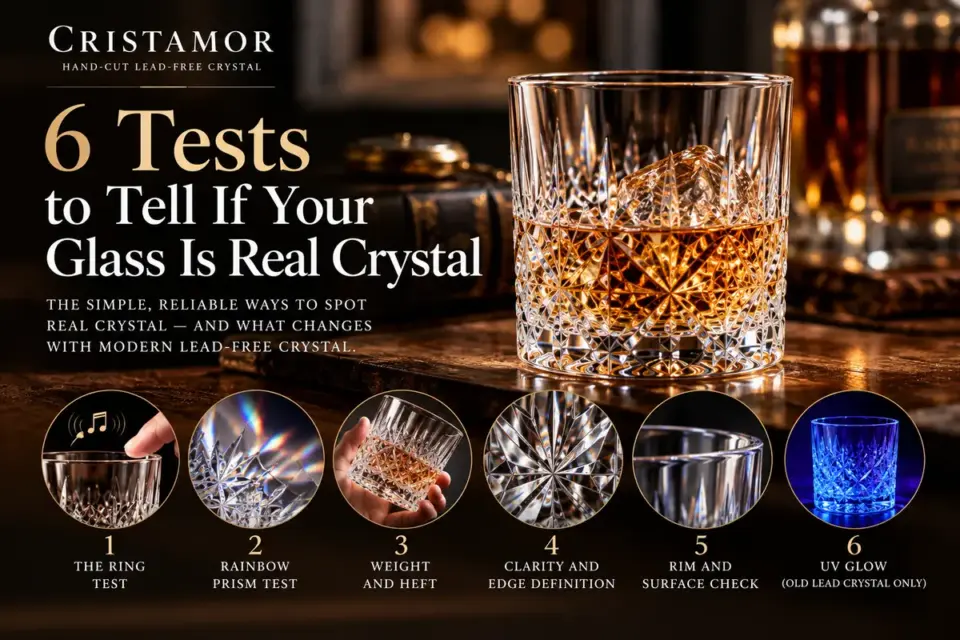
You pick up a glass at an antique store, or unwrap a gift that promises “crystal,” and the same question appears: is this the real thing, or just glass with a good sales pitch? You are not alone — the question comes up constantly in vintage and secondhand communities, where buyers discover their finds fail the tests they read online. The confusion has a real cause: the classic tests were designed for old lead crystal, and modern lead-free crystal behaves a little differently. Here are the six tests that actually work — and the caveats most guides leave out.
What Is Crystal Glass, Actually?
First, a terminology note: “crystal” is not a separate material the way stone or metal is — it is glass with mineral additives that change how it behaves. Traditional crystal added lead oxide, which made glass clearer, easier to cut, and gave it that famous ringing sound. Because of health concerns around lead, most modern premium drinkware uses lead-free crystal instead, where minerals like barium or zinc play a similar role. If you are drinking from it rather than displaying it, that distinction matters — and it also changes what the identification tests will tell you.
Test 1: The Ring Test
This is the most widely cited test, and for good reason. Flick the rim gently with your fingernail or tap it lightly with a spoon:
- Crystal produces a clear, high-pitched, bell-like ring that sustains for a moment — the minerals bond the material more tightly, letting it vibrate like a bell.
- Ordinary glass gives a short, dull thud with no sustain.
Tap very gently — especially with older lead crystal, which is softer than standard glass and can chip from a sharp knock. And keep the caveat below in mind: lead-free crystal also rings, sometimes at a slightly different pitch.
Test 2: The Rainbow Prism Test
Hold the piece up to a light source and look through it. Crystal’s mineral density creates a prism effect — if you see subtle rainbows at the edges or through the facets, that is a strong sign of crystal. Plain glass stays visually flat. This pairs naturally with a sparkle check: well-cut crystal throws small glints of light that ordinary glass cannot match.
Test 3: Weight and Heft
Pick the glass up. Crystal is generally heavier than ordinary glass of the same size because of its mineral content. This is why whiskey drinkers often talk about heft as a quality marker — a substantial, weighted base changes how a glass feels in the hand. Weight alone does not prove anything (thin glass can be made deliberately heavy), but combined with the ring and prism tests it is a reliable supporting clue. If this matters to you, our guide on the hand-feel anatomy of heavy planted sham whiskey glasses breaks down exactly where that weight should sit.
Test 4: Clarity and Edge Definition
Look at the cut edges and the rim. Crystal takes and holds sharper facets, so cut lines look crisp and defined, and the walls look noticeably clear and bright. Regular glass often shows slightly rounded edges and a fainter, greener or murkier cast at thick sections.
Test 5: The Rim and Surface Check
Run a finger around the rim and over any decorated surfaces. Genuine cut crystal feels crisp where the facets meet. Molded imitation “crystal-look” glassware feels smoother and rounder — the pattern was pressed, not cut. Minor wear on old pieces is normal, but a soft, undefined pattern is a strong hint you are holding pressed glass.
Test 6: The UV Glow (For Old Lead Crystal Only)
Under ultraviolet light, old lead crystal can emit a faint blue glow. Treat this as a bonus check rather than a primary test: it works only on leaded pieces, requires a UV source, and — critically — lead-free crystal will not glow. Failing this test does not mean your glass is not crystal; it may simply mean it is the modern, safer kind.
The Lead-Free Crystal Caveat Most Guides Miss
Here is where many guides fall short. If you learned the classic tests, you learned them on lead crystal. Modern lead-free crystal — the kind used in quality drinkware today — behaves differently in ways that confuse people:
- It still rings, because barium and zinc minerals bond the glass tightly — though often at a slightly different pitch than lead crystal.
- It does not show the faint tint that leaded glass can have, and it will not glow under UV.
- It is what you should want for drinking. Lead-free means no lead contact with your whiskey — which is why reputable makers switched.
So if your premium new glass rings, prisms, and feels heavy but fails the “old crystal” UV check, congratulations — you likely own exactly what modern glassmaking intended. If you want to go deeper on the material choice, our optical crystal vs lead crystal guide covers clarity, hardness, durability and safety in detail, and our lead-free crystal buyer’s guide lists what to verify before you buy any piece labeled “crystal.”
Where Price Fits In
Crystal generally commands higher prices than ordinary glass, and antique guides treat that as a given. Price is a useful prior but a poor proof — plenty of mass-produced glass is sold at premium prices with “crystal-look” styling. Use the physical tests first; treat price as context, not evidence.
Quick Reference Checklist
- Gentle tap → sustained bell-like ring (crystal) vs dull thud (glass).
- Light behind the glass → rainbow prism at edges (crystal).
- In the hand → noticeably heavier than a same-size glass tumbler.
- Eyes on the facets → crisp cut lines and bright clarity.
- On the rim → sharp facet junctions, not soft molded rounds.
- Remember the caveat → lead-free crystal rings differently and skips the UV glow; that is normal and preferable for drinking.
The Cristamor Take
Every identification test points at the same underlying qualities: mineral-rich material, precise cutting, and substantial construction. That is exactly what hand-cut lead-free crystal delivers — the ring, the prism, and the heft, without the lead. If you are choosing a format too, our Glencairn vs tumbler comparison matches the glass to your drinking style, and our premium whiskey gift guide covers when crystal makes the gift. Explore the Cristamor collection of hand-cut lead-free crystal whiskey glasses — glassware that passes every test above honestly.