
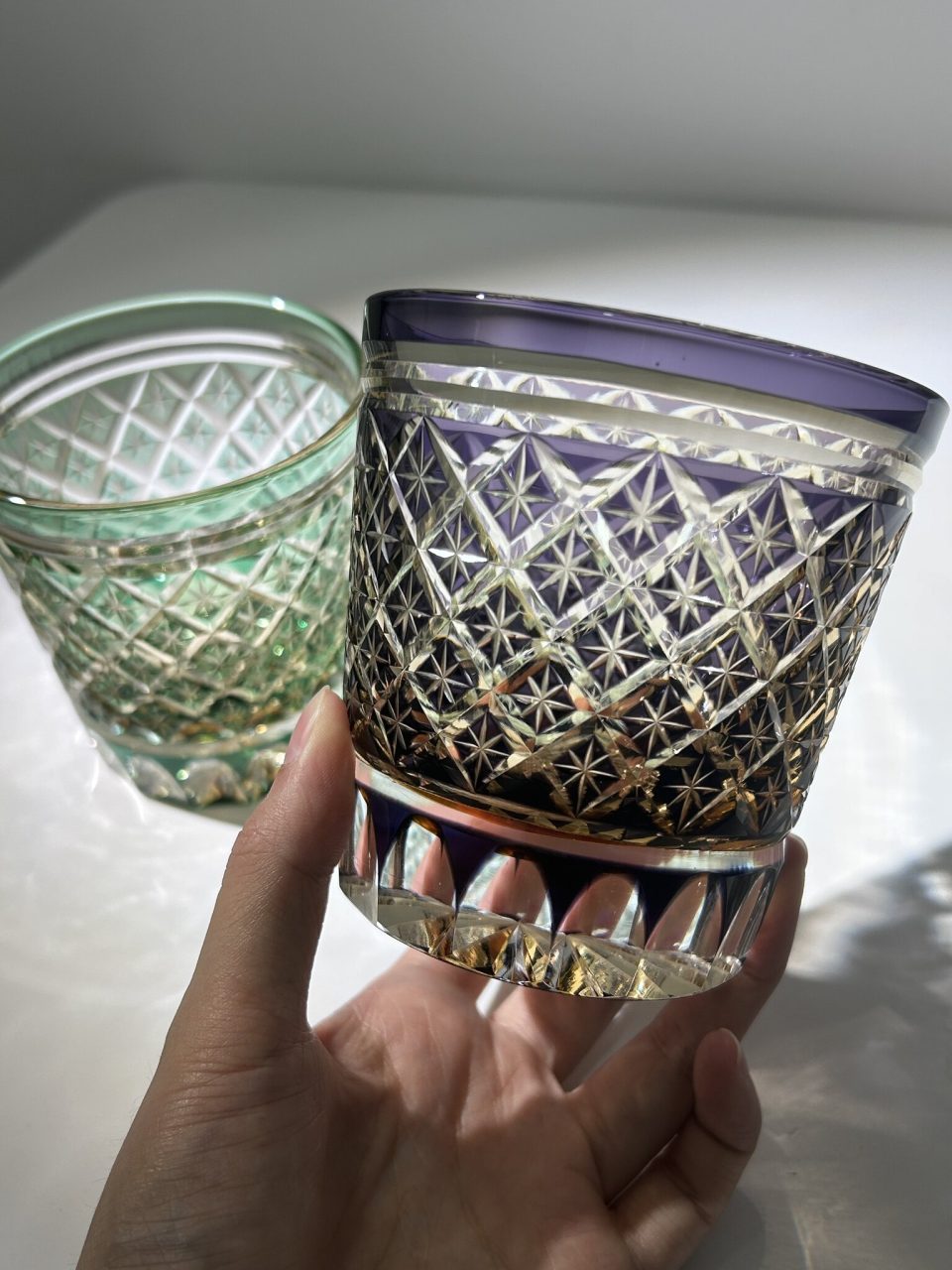
Every Cristamor whiskey glass begins as a block of optical-grade borosilicate crystal — the same material used in telescope lenses and laboratory optics. Transforming this precision-engineered glass into a hand-cut drinking vessel requires a multi-stage process that blends industrial material science with centuries-old artisanal technique. Here is how it happens.
1. The Material: Optical-Grade Borosilicate Crystal
The story starts with the raw material. Optical borosilicate crystal (commonly designated as K9 or BK7) is a specially formulated crown glass with a refractive index of approximately 1.516 and an Abbe number of 64. Its chemical composition — roughly 69% silicon dioxide, 11% boron oxide, 10% sodium oxide, 6% potassium oxide, and 3% barium oxide — is engineered for optical homogeneity, meaning the glass has no internal striations, bubbles, or density variations.
This optical purity is what makes the material so desirable for drinkware. When light enters a properly cut borosilicate crystal glass, it travels through without scattering, producing the deep, water-clear transparency and sharp light refraction that define a premium whiskey tumbler. Ordinary soda-lime glass simply cannot achieve this level of clarity.
2. Melting and Homogenization
The raw ingredients — silica sand, boron oxide, sodium carbonate, potassium carbonate, and barium carbonate — are weighed precisely and mixed with cullet (recycled glass fragments) to ensure consistent melting. The batch is charged into a furnace at approximately 1,400 to 1,500 degrees Celsius, where it melts over the course of 12 to 24 hours.
During melting, the molten glass must be continuously refined to eliminate bubbles. The boron oxide in the formulation plays a critical role here: it lowers the viscosity of the melt, allowing trapped gases to rise and escape more easily than they would in ordinary glass. The result is a homogeneous, bubble-free glass blank — an absolute requirement for optical-grade material.
3. Forming the Blank: Hand Blowing and Molding
Once the molten glass reaches the correct working temperature (around 1,100 degrees Celsius), a glassblower gathers a blob of glass on the end of a blowpipe. The glass is initially shaped by rolling it on a polished steel surface called a marver, then inflated by mouth to create a hollow form.
For whiskey tumblers, the inflated glass is placed into a wooden or graphite mold that gives the vessel its basic cylindrical shape. The glassblower rotates the blowpipe continuously while the glass settles against the mold walls, ensuring even thickness. The bottom of the glass is flattened using a paddle or by pressing against a flat surface, and the rim is trimmed to the correct height with shears while the glass is still hot and pliable.
The formed blank is then transferred to an annealing lehr — a long kiln that slowly cools the glass from around 550 degrees Celsius to room temperature over several hours. This controlled cooling process relieves internal stresses that would otherwise cause the glass to crack or shatter during cutting. For optical-grade borosilicate, the annealing schedule is particularly precise because the material’s lower thermal expansion coefficient (approximately 7.5 x 10⁻⁶/K) requires careful temperature management.
4. Marking the Pattern
After annealing, the cooled blank is cleaned and inspected for optical quality. Any piece with visible bubbles, striations, or surface imperfections is rejected at this stage. The approved blank is then handed to a pattern marker — a craftsperson who draws the cutting guidelines directly onto the glass surface using a specialized marking pen or paint.
The pattern is drawn freehand, guided by the marker’s experience and a mental template of the design. Unlike machine-pressed glass, where the pattern is molded into the surface, hand-cut crystal requires each line and facet to be individually planned and executed. This is where the artisan’s skill becomes irreplaceable — the pattern must account for the glass’s curvature, the placement of each facet relative to the others, and the way light will travel through the finished piece.
5. Hand Cutting: The Heart of the Process
The cutting is performed on a rotating diamond or carborundum wheel. The craftsperson holds the glass against the spinning wheel, which grinds away the glass surface to create facets, grooves, and geometric patterns. The process uses two primary types of cuts:
- Flat cuts (miter cuts): Created using an angled wheel, these produce sharp, planar facets that catch and reflect light. Most decorative patterns are built from combinations of flat cuts at different angles.
- Beveled cuts (slice cuts): Created using a round-edged wheel, these produce concave grooves that add depth and texture to the design.
A cutting emulsion — typically a mixture of emery powder and water or kerosene — is applied to the wheel during cutting. This abrasive slurry does the actual grinding, while the wheel’s rotation provides the force. The craftsperson controls the depth and angle of each cut through pressure and positioning, a skill that takes years to master.
A single whiskey tumbler may require 30 to 60 individual cuts, depending on the complexity of the pattern. Each cut must be precisely positioned and angled to create a cohesive design. Because optical borosilicate crystal is harder than ordinary glass (Mohs 7 versus 5.5), the cutting process takes longer and demands more from both the tools and the artisan. But this hardness is also what allows the finished facets to hold their crisp edges — a quality that softer glass cannot match.
6. Smoothing and Polishing
Raw cuts leave a matte, frosted surface on the glass. To restore transparency and create the characteristic sparkle of cut crystal, each facet must be polished. This is typically done in two stages:
- Stone smoothing: A fine-grained stone wheel is used to smooth out the rough texture left by the cutting wheel, bringing the surface to an even, satin finish.
- Polishing: The facet is then polished to optical clarity using a cork or felt wheel with a cerium oxide polishing compound. Cerium oxide is a rare-earth abrasive that chemically reacts with the glass surface at a microscopic level, producing a flawless, glass-smooth finish.
Some manufacturers use acid polishing as an alternative — immersing the cut glass in a hydrofluoric acid solution that dissolves the surface layer. However, hand polishing produces sharper facet edges and is preferred for high-end crystal, where the definition of each cut matters.
7. Final Inspection and Quality Control
The finished glass undergoes a final inspection under controlled lighting. Inspectors check for:
- Optical clarity — no internal bubbles, striations, or color cast
- Cut precision — each facet should be sharp, even, and properly positioned
- Surface quality — no scratches, chips, or polishing residue
- Structural integrity — no micro-cracks from the cutting process
- Weight and balance — the glass should feel substantial and sit level on a flat surface
Only glasses that pass every check are accepted. The rejection rate for hand-cut optical crystal is significantly higher than for mass-produced glassware, which is part of why each piece commands a premium price.
Why Optical Borosilicate Makes a Difference
Using optical-grade borosilicate crystal instead of ordinary glass or lead crystal offers several distinct advantages for whiskey drinkware:
- Superior clarity: The optical-grade homogeneity means light passes through without scattering, giving you a crystal-clear view of your whiskey’s color and texture
- Lead-free safety: Unlike traditional lead crystal, borosilicate optical glass contains no lead, making it completely safe for all beverages
- Harder surface: Mohs 7 hardness means the cut facets stay sharp longer and the glass is more resistant to scratching and clouding
- Chemical inertness: Borosilicate glass resists etching from acidic spirits and is dishwasher safe
- UV stability: The glass will not yellow or degrade over time, even with prolonged exposure to sunlight
Conclusion
The path from raw optical borosilicate crystal to a finished hand-cut whiskey tumbler is a journey through multiple disciplines: materials science, glassblowing, precision cutting, and hand polishing. Each step demands skill, patience, and an uncompromising standard for quality. The result is a glass that does more than hold whiskey — it transforms the drinking experience, refracting light through precise facets, revealing the spirit’s color with optical clarity, and sitting in the hand with a weight and balance that mass production simply cannot replicate.
At Cristamor, every glass in our collection is crafted through this process. Explore our hand-cut crystal collection to find the piece that speaks to you.