
You’ve spent years building your collection. You’ve hunted down limited releases, debated mash bills with strangers on the internet, and spent more on a single bottle than most people spend on dinner for two. But when you finally pour that prized dram into your glass, the experience falls flat — not because of the whiskey, but because of what you’re drinking it from.
Let’s talk about the three problems nobody at the tasting room mentions, but every whiskey drinker has quietly dealt with.
1. Lead Crystal Is Poisoning Your Pour
That heavy, faceted tumbler you inherited from your grandfather? The one that catches the light beautifully and makes you feel like you’re drinking in a 1920s speakeasy? It’s probably leaching lead into your whiskey.
Traditional lead crystal contains 24–32% lead oxide. That’s what gives it the weight, the brilliance, the prism-like refraction that makes it sparkle. But the same lead that makes the glass beautiful also makes it toxic.
How bad is it?
Studies by researchers at the University of Plymouth and the FDA have shown that lead crystal can release measurable amounts of lead into acidic beverages — and whiskey, with its typical 40% ABV and congeners, acts as a particularly effective solvent. The longer your whiskey sits in the glass, the more lead migrates into it.
We’re not talking about instant poisoning. We’re talking about cumulative exposure — the kind that builds up over decades of daily use. Chronic lead ingestion, even at low levels, is linked to:
- Cognitive decline and memory issues
- Elevated blood pressure
- Kidney damage
- Fatigue and mood changes
If you’ve been drinking from lead crystal for years, you’re not going to drop dead tomorrow. But you’re also not doing your body any favors. And if you’ve been pouring whiskey for guests from that same decanter — the one that’s been sitting with spirits inside for months — the concentration only gets worse.
The solution
Switch to lead-free crystal. Modern lead-free crystal replaces lead oxide with potassium oxide, barium oxide, or zinc oxide. These alternatives achieve similar brilliance and weight without the toxicity.
Look for glasses explicitly labeled as:
- Lead-free crystal
- Optical-grade crystal glass (borosilicate-based, ultra-clear and durable)
- Hand-cut lead-free crystal (for the traditional cut-glass aesthetic without the health risk)
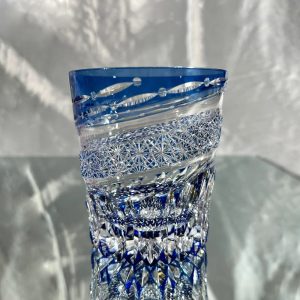
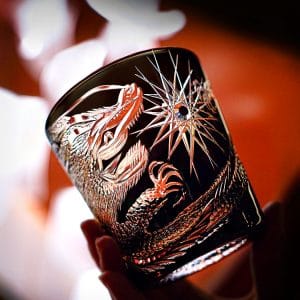
The best modern whiskey glasses offer the same hand-cut precision and optical clarity as traditional lead crystal, but are made from food-safe, lead-free glass that will never contaminate your spirit.
2. Your Glasses Are Turning Cloudy — And It’s Not Your Fault
You pull your favorite whiskey glasses out of the dishwasher. They look like they’ve been rubbed with chalk. The surface is hazy, the clarity is gone, and no amount of polishing brings back that razor-sharp transparency.
This is one of the most common complaints among whiskey enthusiasts, and it’s almost always blamed on the dishwasher detergent. But the real culprit is a chemical reaction between the detergent and the glass itself.
What’s actually happening
Most glassware — even so-called “crystal” — is made from soda-lime glass. It’s affordable, widely available, and used by nearly every mainstream glassware brand. But soda-lime glass has a critical weakness: its surface is chemically unstable under high-pH conditions.
Dishwasher detergents are alkaline (pH 10–12). During a hot wash cycle, the detergent essentially etches the glass surface, dissolving silica and leaving behind micro-pitting. The result is permanent cloudiness that no amount of vinegar or polishing can fix — because the damage is etched into the glass itself.
This is not a stain. It’s not residue. It’s structural damage to the glass surface.
Why it matters for whiskey
Cloudy glass doesn’t just look bad — it actively degrades your tasting experience:
- Visual clarity is lost. Whiskey’s color — from pale gold to deep amber — is a key part of the tasting ritual. Cloudy glass mutes those colors.
- Aroma escapes faster. Micro-pitting creates more surface area, which means volatile aromatics dissipate more quickly.
- The glass ages. Each wash cycle degrades the surface further until the glass is ruined.
The solution
Invest in borosilicate or optical-grade crystal glass. These glasses have a different chemical composition — lower thermal expansion, higher chemical resistance — that makes them virtually immune to dishwasher etching.
A quality borosilicate glass will survive hundreds of dishwasher cycles without a single cloud spot. The clarity you see on day one is the clarity you’ll see on day one thousand.
If you prefer hand-cut crystal aesthetics, look for optical-grade crystal glass — it combines the visual brilliance of cut crystal with the chemical durability of borosilicate.
And if you’re still using soda-lime glasses? Wash them by hand with warm water and mild soap. Never put them in the dishwasher.
3. Ice Cubes Are Destroying Your Glass
You drop a cube into your tumbler. You hear it clink against the sides. You swirl. What you don’t see — at least not at first — is the microscopic damage happening to the inner wall of your glass.
Every time ice hits the glass, it leaves a mark. Not a dramatic crack or chip, but a tiny abrasion — a hairline scratch on the interior surface. Multiply that by dozens of ice drops, hundreds of swirls, and years of regular use, and your glass develops a cloudy, scuffed interior that kills clarity and traps residue.
Why most glasses can’t take the hit
The Mohs hardness scale measures how resistant a material is to scratching. Here’s how common glass materials compare:
| Material | Mohs Hardness |
|---|---|
| Ice (mineral-hard water) | 1.5–2 |
| Standard soda-lime glass | 5–5.5 |
| Lead crystal | 5–6 |
| Borosilicate glass | 6–6.5 |
| Optical-grade crystal glass | 6.5–7 |
| Quartz | 7 |
Ice itself is relatively soft, but mineral-rich water (the kind that makes “good ice” — clear, slow-melting cubes) contains calcium and magnesium deposits that push the effective hardness higher. When that ice grinds against a glass wall rated at 5 on the Mohs scale, the glass loses.
The result: thousands of micro-scratches that create a frosted look on the inside of your glass, even as the outside still looks fine.
Why this matters for whiskey
A scratched interior isn’t just cosmetic. It affects taste:
- Trapped residue. Micro-scratches trap oils, tannins, and residue from previous pours. Even after washing, trace compounds linger in those microscopic grooves.
- Flavor contamination. Over time, these residues build up and subtly alter the flavor profile of each new pour. Your 15-year-old single malt picks up ghost notes from yesterday’s cask-strength.
- Aroma disruption. A smooth interior surface allows whiskey to sheet evenly, releasing aromas in a controlled way. A scratched surface creates turbulence that disrupts this flow.
The solution
Choose glasses made from harder crystal. Optical-grade crystal glass, with a Mohs hardness of 6.5–7, resists ice abrasion far better than standard glass or lead crystal. These glasses will maintain their interior clarity for years, even with daily ice use.
Additionally, look for glasses with thicker base construction — a heavy, solid base not only feels better in the hand but provides structural resistance to ice impact.
And when it comes to ice itself, consider using a single large cube or sphere rather than multiple small cubes. One large piece of ice has less surface contact with the glass walls and melts more slowly, reducing both thermal shock and abrasion.
The Bottom Line
Whiskey deserves better than a glass that’s slowly poisoning it — literally and figuratively. The three problems above — lead contamination, dishwasher clouding, and ice abrasion — are silent killers of the whiskey experience. You don’t notice them happening until one day, you pour a dram you’ve been saving for a special occasion, and something feels… off.
The fix isn’t complicated. It comes down to choosing the right material:
- Lead-free for your health
- Borosilicate or optical-grade crystal for dishwasher durability
- High-hardness glass for ice resistance
Modern hand-cut crystal glasses exist that check all three boxes — the same artisan craftsmanship, the same visual brilliance, the same weight and presence — but made from materials that won’t leach, cloud, or scratch.
Your whiskey has already been through years of aging in oak. The least you can do is put it in a glass worthy of the journey.