
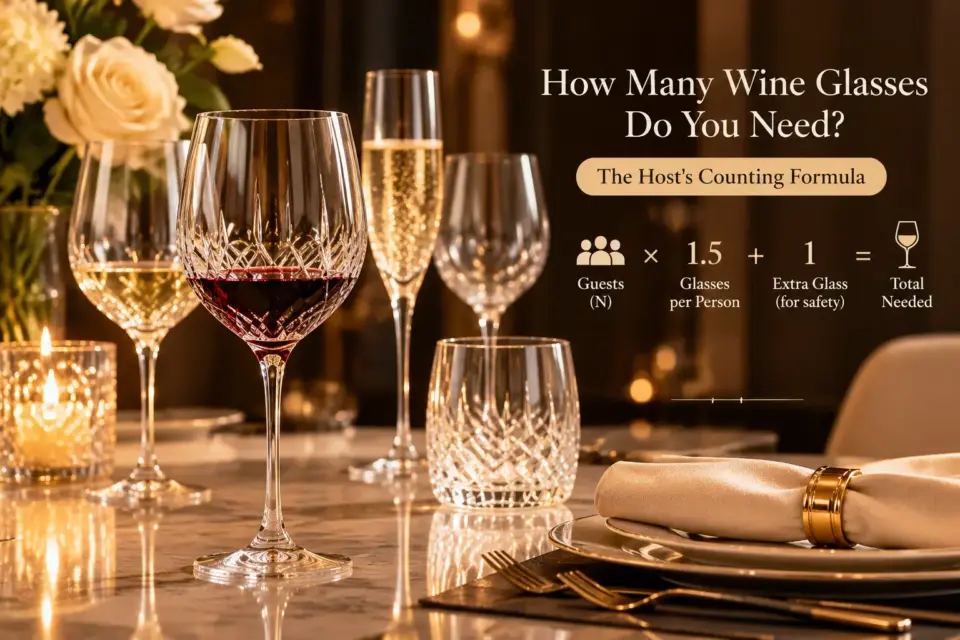
Every dinner party host eventually faces the same quiet math problem: how many wine glasses are actually enough? Too few and you are washing glasses between courses; too many and your cabinet fills with pieces that never leave the shelf. The good news is that the counting is simpler than it looks — one formula plus one ownership baseline covers almost every situation.
Start with the per-person formula
Etiquette and planning guides converge on the same starting point: at least two glasses per person for a typical dinner party lasting two to three hours — the welcome drink as guests settle in, plus refills across the table. Longer evenings scale up from there: planning guides suggest roughly one glass per guest per hour, so a three-hour dinner works out to about three to four glasses per drinking guest once the welcome round is included.
Two practical adjustments keep the formula honest:
- Pacing: guests drink fastest in the first hour — pour the welcome round generously, then slow down.
- Not everyone drinks wine: count your wine drinkers, not your total guest list, and keep water glasses on the table so wine glasses are not emptied just to stay hydrated.
The ownership baseline: how many glasses to actually own
Per-person math tells you how many glasses a single evening needs. For the cabinet, hosting guides point to a clear baseline: frequent hostesses do well with eight wine glasses plus eight water glasses, built around the classic rule that no more than eight people makes a perfect dinner party. Households that entertain less often land comfortably in the eight to twelve wine glasses total range.
If you are starting from zero, that breaks down into a simple ladder:
- 4-6 guests regularly: four to six red wine glasses plus four to six slightly smaller white wine glasses.
- 8+ guests or frequent hosting: the full eight-plus-eight baseline, so a full table never leaves anyone glassless.
- Every collection: a couple of spares for breakage — because between the sink and the shelf, accidents happen.
Red, white, or universal?
The red-and-white split is traditional — white wine glasses are slightly smaller, concentrating delicate aromas, while red glasses give bolder wines room to breathe. If cabinet space is tight, universal glasses cover both styles acceptably for casual dinners; the split earns its keep as your dinners become more deliberate. Serious tasters may still keep dedicated tasting glasses for evaluation — but for hosting, versatility beats specialization.
Breakage spares are part of the count
Buying guides consistently include spares in the recommended totals — and for good reason. Thin, cheap glasses are exactly the ones that chip in the wash and crack at the worst moment. This is also why material matters as much as count: lead-free crystal survives daily hosting far better than cheap glass, and the feel of the glass — weight, balance, a polished rim — decides whether guests reach for it: what makes a glass feel good in the hand.
When to upgrade from a starter set
The upgrade moment is easy to recognize: your dinners outgrew four guests, you are washing the same two glasses between courses, or one chip too many thinned the ranks. That is when a proper hosting-grade set — matched glasses, real weight, a presentation box for storage — replaces the starter mismatch. If you are also weighing how many glasses a gift set should include, our glass set buyer’s framework covers the gift side in depth.
The 60-second glass-count checklist
- Per person: at least two glasses for a 2-3 hour dinner; add one per extra hour.
- Ownership: 8-12 wine glasses for a hosting household; 8+8 (wine + water) if you regularly seat eight.
- Split: 4-6 red + 4-6 white, or universal if space is tight.
- Spares: two minimum — breakage is a when, not an if.
- Material: lead-free crystal or honestly named glass; vague listings walk away.
The bottom line
How many wine glasses do you need for a dinner party? Two per person for the evening, eight to twelve in the cabinet if you host regularly, and a couple of spares to keep the count honest. That standard — hand-cut lead-free crystal, real weight, polished rims, built for years of dinners — is what every Cristamor set is made to. Browse the Cristamor collection and pick the set size that matches your table. And if the occasion is a gift rather than your own cabinet, the premium gift selection guide walks through the choices that make a set memorable.