
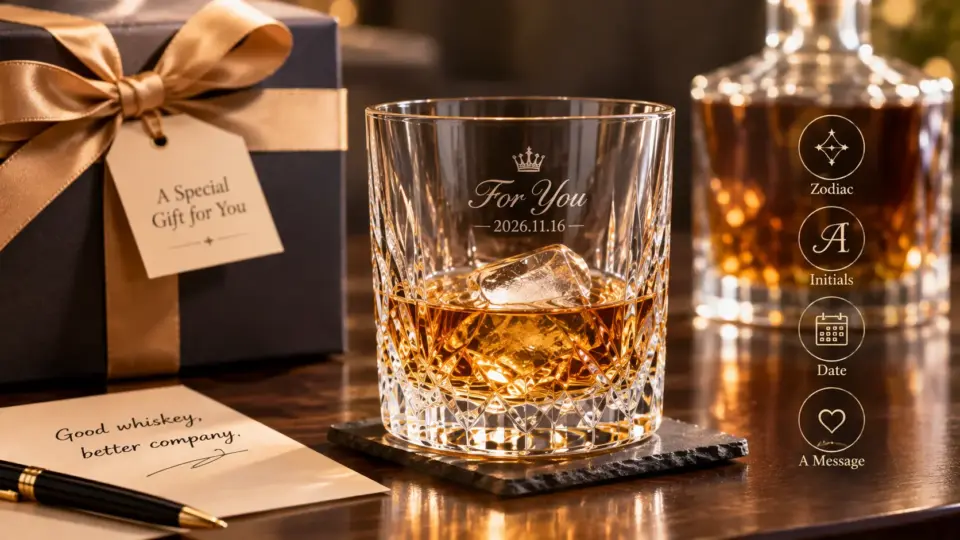
Two whiskey gifts can hold the exact same glassware and still land completely differently. One feels like it was pulled off a shelf in the checkout lane. The other feels like it was chosen — for a specific person, with their habits and their name in mind. The difference is rarely money. It is personalization, done deliberately.
The good news: making a whiskey gift feel personal is not a talent thing. It is a short framework — match the item to how the recipient actually drinks, choose engraving that fits the occasion, and learn to tell real personalization quality from the mass-produced version. Here is the whole framework.
Start with how they actually drink
Gift guides keep landing on the same first step, and it is the right one: the most personal whiskey gift is the one that matches the recipient’s routine. Before choosing anything, sort them into one of three drinkers.
The sipper
Someone who enjoys whiskey straight, slowly, at home or at tastings. Their most-used gift is glassware — a proper tasting or rocks glass they will reach for weekly. Glassware and tasting sets are the classic pick here precisely because they enter the nightly ritual, not the cabinet.
The cocktail maker
Someone who mixes. A bold, mixable bourbon or rye, a proper mixing glass, and quality bar accessories (jiggers, ice molds, smokers) will see far more use than another display bottle. Personalizing the tool they actually hold — the mixing glass, the bar spoon stand — lands harder than personalizing something they only look at.
The host
Someone who pours for others. For hosts, a complete set is especially helpful: decanter, glasses, stones — the matching already done, ready to be presented to guests. If you know they like to host, a set built for serving is the personal choice, because it supports the thing they actually enjoy doing.
Getting this one step right is what separates “thoughtful” from “generic”. A perfect glass for a sipper is a wrong gift for a highball-drinker who never pours it neat — the item did not match the person.
Choose engraving that carries meaning, not just a name
Engraving is the strongest personalization lever in whiskey gifting — with the right text. A monogram, a family name, a date, or a short message gives the piece a sense of ownership and story. It signals that the gift was chosen for him or her — not simply purchased off a shelf for anyone.
Engraved whiskey glasses with a name, a date, or a special message are the most common form, and for good reason: the glass is the object the recipient touches every time they pour, so the personalization is felt in use, not just on display. If you are weighing whether engraving is worth it at all — including how it affects durability and resale — see our full breakdown: personalized whiskey glass: is engraving worth it?
Match the message to the occasion
Personalization has a failure mode: the message that over-reaches. The rule from personalization guides is simple — the message must be appropriate for both the occasion and the relationship. For formal occasions like corporate milestones or weddings, choose sophisticated, understated designs: initials, a clean monogram, a significant date. Save inside jokes and long heartfelt inscriptions for close personal occasions where they will land as intended. Understated is not less personal — it is personalization the recipient is comfortable displaying.
Learn to spot real engraving quality
Here is the part most buyers miss: “personalized” does not automatically mean “well made”. Mass-produced sets often use light surface etching, while premium personalization uses deep engraving that holds its crisp edges for years. From a product listing, look for signals of depth: hand-engraving or deep-etch claims, close-up photos of the engraving itself, and honest material descriptions (lead-free crystal, clearly named glass types). If a listing stays vague about both material and engraving depth, treat the vagueness as the answer. Our six-test guide to telling real crystal from cheap glass covers the material side: how to tell real crystal from cheap glass.
The small touches that compound
Personalization is not only engraving. Around the main gift, small touches stack: a handwritten message instead of a printed card, custom gift tags, a curated snack that matches their pour, a printed cocktail recipe they can actually make. None of these is impressive alone — together they transform a simple collection into a thoughtful present, because each one says the same thing: this was assembled for you.
The intentionality test
At the premium end, the question shifts. It is no longer “how much is in the box?” but “how intentional is every part of this gift?” — rarer whiskey, a better tasting format, better storytelling, or personalization that makes the set feel commissioned rather than purchased. You do not need a luxury budget to apply the test. One deliberate engraving choice plus one matching ritual item beats a packed box of filler every time.
A 60-second personalization checklist
- Routine: do they sip, mix, or host? Pick the item they will actually hold weekly.
- Engraving text: monogram, family name, date, or one short line — ownership and story, not an essay.
- Occasion fit: formal occasion means understated design; personal occasions can go warmer.
- Quality check: deep engraving over light etching; lead-free crystal or a clearly named glass type.
- One human touch: a handwritten line beats any printed card.
The bottom line
How do you make a whiskey gift more personal? Match the item to the recipient’s drinking routine, engrave something that fits both the person and the occasion, and verify the personalization quality before you buy. A gift built that way stops being merchandise and becomes a keepsake — the piece they reach for, use, and remember.
That standard is what we build every Cristamor set around: hand-cut lead-free crystal, real weight, polished rims, and presentation boxes made for the moment of unboxing. Whether you start from our whiskey glass set buyer’s framework or go straight to the Cristamor collection, pick the set that matches their routine — then make it theirs.