
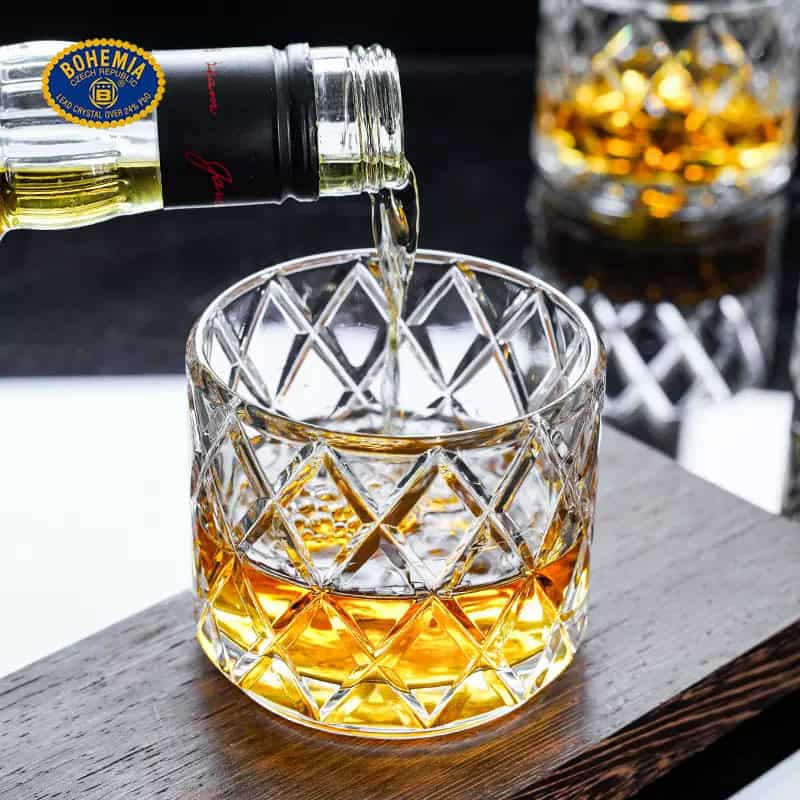
Most crystal whiskey glass buying advice stops at “it looks nice.” That’s a problem, because the differences between glasses are measurable, explainable, and worth understanding before you spend. Glassware reviewers and suppliers have spent the last two years turning whiskey glass features into real specs — rim geometry, base weight, ice clearance, finish quality — and the honest buyer should read them that way.
This guide translates the spec talk into plain English: what rim diameter actually does to aroma, why base weight is an engineering claim you can feel, what “lead-free” means in chemistry terms, and the care reality nobody puts on the gift box. Then you can pick the glass that matches your pour — not the marketing.
Spec #1: Rim Geometry — the Aroma Dial
Rim diameter is the most-explained aroma feature in current glassware guides, and the mechanism is simple. As Taster’s Club puts it: “small diameter rims keep the smell concentrated on the nose, wide diameter rims disperse alcohol.” Tulip-shaped crystal glasses take it further, concentrating vapors at a narrow rim so you catch more of the whiskey and less of the sting.
So the first decision writes itself:
- Learning to taste? A narrower, tulip-style rim concentrates aroma — the tasting-glass school.
- Drinking casually, over ice? A wider rim disperses alcohol burn and leaves room for the pour — the rocks-glass school.
Neither is wrong. They’re two different tools, and buyers should treat them that way. Community wisdom agrees: enthusiast forums land on a narrow tasting glass as the consensus starter, with a heavy-base rocks glass as the natural second glass.
Spec #2: Base Weight — an Engineering Claim You Can Feel
Weight isn’t decoration — reviewers test it. In Serious Eats’ glass testing, heavier bases “stood up well while muddling ingredients and made the glasses more difficult to tip over.” Another retailer describes a “heavy diamond-cut base” giving glasses a stable, planted feel. The engineering story is real: a low center of gravity means tip-resistance, and tip-resistance matters once there’s whiskey in the glass.
What to check in hand: a solid base that sits flat, weight that sits low in the glass, and balance that doesn’t feel top-heavy when empty.
Spec #3: Ice Clearance — the Overlooked Number
Big ice is standard practice now, and rim/capacity specs decide whether it fits. Cocktail guides note that a 2-inch ice cube can displace two to three ounces on its own, which is why capacity spec sheets matter; wholesale specs we reviewed advertise an 85 mm wide rim that seats large ice spheres and standard 2-inch cubes. If you drink on the rocks, check the capacity figure — not just the photo.
Spec #4: The Finish — Where Quality Shows Last
Final-mile quality lives at the rim. On well-finished cut-crystal tumblers, the “polished rim band stays clear for a comfortable mouthfeel on whiskey,” as one supplier spec puts it, with consistent thickness checked across production. Run a finger around the rim of any glass you’re considering: it should feel smooth and even, never sharp or wavy.
Spec #5: The Material — What “Lead-Free” Actually Means
Here’s the spec most buyers never read. Traditional crystal used lead oxide; modern lead-free crystal swaps it for barium, zinc, titanium, and potassium oxides — a substitution approach standardized through the 1990s by major European glasshouses, as one crystal-education guide recounts. The practical takeaway: lead-free is mature chemistry, not a compromise, and it should be the default filter for anything you drink from. We break down the material itself in K9 crystal vs. lead-free crystal and what makes K9 optical crystal different.
The Spec-Transparency Checklist
The personalized-glass market has converged on an advertised standard stack — “chip-resistant, lead-free and dishwasher-safe, laser engraved” appears near-verbatim across gift retailers. Use that convergence as your benchmark: a serious seller states its specs. Before buying any crystal glass, look for:
| Spec | What to look for | Why it matters |
|---|---|---|
| Rim diameter & shape | Stated rim figure; tulip for tasting, wider for rocks | Aroma concentration vs dispersal |
| Base weight | Heavy, low-sitting base | Stability and tip-resistance |
| Capacity | Stated fl oz / ml; room for large ice if you use it | Big cubes displace 2–3 oz on their own |
| Material | Named lead-free crystal (e.g., K9 optical) | Safety without the lead question |
| Finish | Polished rim band, consistent thickness | Comfortable mouthfeel, quality control |
| Care | Honest dishwashing guidance | Etching from dishwashers is permanent |
One care note deserves its own headline: cloudiness from dishwasher exposure is a documented, permanent problem for fine glass — the how-to ecosystem of vinegar soaks exists because prevention beats cure. For the full reality, see our guides to crystal and the dishwasher, cleaning without cloudiness, and complete hand-cut crystal care.
Cut Design: the Spec You Can See
Visual design is a marketed premium feature for good reason — suppliers describe “diamond and starburst cuts” catching light to create “visual depth for the guest,” paired with presentation boxes that signal quality. When you’re choosing between two honest spec sheets, cut design is the tiebreaker: real hand-cut facets have crisp edges, depth, and light play that machine-pressed patterns can’t fake. We wrote the field guide: how to spot real hand-cut crystal.
And if the glass is a gift, note the codified gift-set anatomy: an engraved glass, whiskey stones, and a personalized box (pinewood or cedar) is the standard — with premium sets adding a decanter. Engraving, in particular, is the feature that turns a spec sheet into a keepsake.
The Cristamor Spec Sheet
We believe specs should be stated, not implied. Cristamor glasses are hand-cut from K9 lead-free optical crystal, with each model’s optimized use case stated plainly — from the everyday-luxury Clear Prism hand-cut tumbler to the light-catching Amber Fuji Wave. Every glass ships gift-ready with free engraving included, and the full collection lists capacity and care honestly.
Frequently Asked Questions
Does rim diameter really change how whiskey tastes?
It changes what you smell — which is most of taste. Narrow rims concentrate aroma at the nose; wide rims disperse alcohol burn. Glassware guides treat rim geometry as the number-one aroma feature for exactly this reason.
Is lead-free crystal as good as traditional crystal?
The chemistry is mature: lead-free crystal replaces lead oxide with barium, zinc, titanium, and potassium oxides — standardized by major European glasshouses back in the 1990s. You get clarity and cut without the lead question.
What specs matter most for a gift?
Material disclosure, finish quality (a polished rim band), and gift-readiness. Add engraving and the gift becomes a keepsake — that’s the feature gift retailers converge on first.
The Last Wrap
Buy whiskey glasses the way you’d buy any precision object: read the specs, feel the weight, check the finish, verify the material. The right glass isn’t the prettiest photo — it’s the one whose rim, base, capacity, and crystal match how you actually pour.
Ready for specs you can trust? Explore the Cristamor hand-cut K9 lead-free crystal collection — every model states its use case, every glass ships gift-ready with free engraving.