
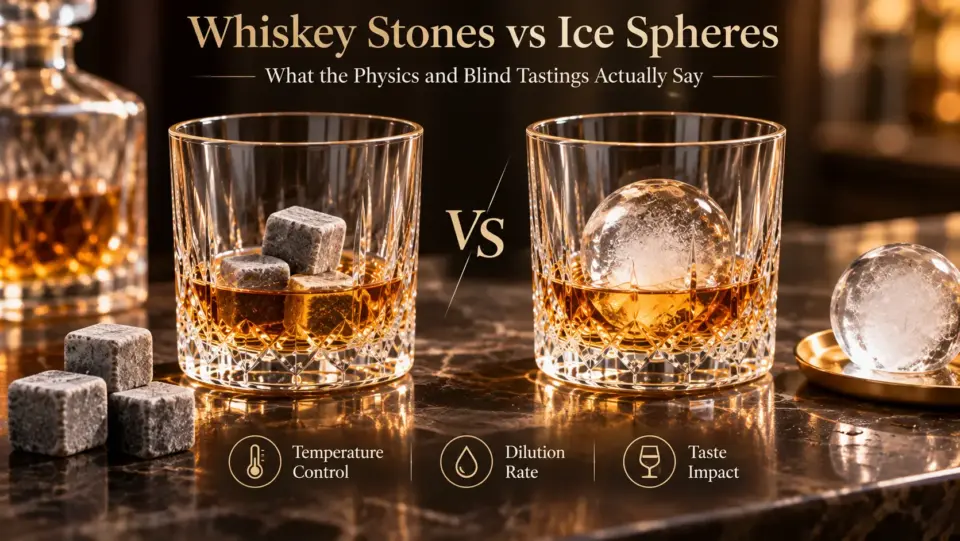
Drop “whiskey stones” into a search bar and you’ll find two warring camps: accessory sellers promising “chilled whiskey with zero dilution,” and whiskey veterans insisting stones are glorified gravel. Both sides are half right. The disagreement isn’t about taste preference — it’s about physics that most product pages quietly skip.
This guide settles the whiskey stones vs ice spheres question the honest way: the actual heat-transfer mechanics, what blind tasting numbers show, where each option genuinely wins, and a simple decision rule you can apply to your own pour. Searches for this comparison keep climbing (“whiskey stones” alone draws roughly 8,100 monthly searches), which tells you how many drinkers are stuck between marketing and physics.
The Physics: Why Ice Cools and Stones Mostly Don’t
Two mechanisms separate these chilling methods, and neither favors stones.
Mechanism 1: Heat Capacity
As Whisky Advocate explains, stones have a lower heat capacity than ice — it takes far less energy to warm a stone than to melt ice. A soapstone cube pulled from the freezer carries only the “cold” it absorbed there; once that small reserve equalizes with your drink, the stone is just a rock in your glass.
Mechanism 2: The Melting Reservoir (Phase Change)
Melting ice isn’t a flaw — it’s the engine. Ice absorbs a large amount of energy as it changes from solid to liquid (the phase change), which is why it can hold a drink cold for an hour. Mixology Notes puts it plainly: stones chill far less and can’t hold cold for long because there’s no melting reservoir to draw from. This is also why dilution isn’t sabotage: a 2017 Scientific Reports study found that added water pushes guaiacol — the compound behind smoky whiskey’s character — toward the surface of the glass, which is why a few drops of water open up a high-proof pour.
What Blind Tastings Actually Show
Laboratory claims are one thing; sipping is another. One widely cited blind comparison scored the same whiskey three ways:
- Ice cubes: peat mellowed to 7.1/10, burn fell to 3.3/10, and overall enjoyment peaked at 8.9/10
- Soapstone stones: peat stayed at 8.6/10, burn only eased to 7.2/10, enjoyment averaged 5.4/10 — tasters described the dram as “warm and flat”
- Stainless steel spheres: burn dropped to 5.1, enjoyment 6.8/10 — but 12 of 42 tasters noticed a faint “cold metal” aftertaste
A separate stones-vs-steel test added a material warning: about 73% of tasters reported a faint mineral aftertaste in the final third of the glass. Steel variants also showed strong thermal lag — cooling slowed by roughly 62% between minutes two and four.
Material quality matters too. Whiskey stones typically run $12–35 per set, but their utility fades across repeated freeze–thaw cycles: soapstone can develop microfractures, stainless steel builds condensation traps, and low-grade composites may leach trace minerals. Professional bars sidestep all of it with calibrated ice — precision chilling that stones can’t approach.
Where Whiskey Stones Genuinely Win
To be fair, stones have one defensible use case. If you prefer your whiskey neat but slightly less warm — a small temperature drop with zero dilution — stones deliver exactly that. As one comparison puts it: ice transforms the drink, stones preserve it. For cask-strength pours you want to nose repeatedly without dilution drift, or for a short session where a 5–10°F nudge is enough, stones are a legitimate choice.
The honest framing: stones are a niche tool for a specific preference, not a universal upgrade over ice.
The Decision Rule: Which One Is Yours?
- You drink high-proof bourbon or cask-strength Scotch: a large ice sphere wins — controlled dilution opens the aroma (the guaiacol effect) and the phase change keeps it cold for a long sip.
- You sip standard-proof whiskey neat and dislike dilution: stones are defensible — expect a small chill, no meltwater, and unchanged flavor concentration.
- You want maximum cold with minimal dilution: one large sphere beats a handful of cubes — lower surface-area-to-volume ratio means slower melting. That’s why ice ball molds became a whiskey-bar standard.
- You bought stones as a gift and wondered: they’re an elegant novelty — fine for the ritual, but don’t expect them to out-chill ice.
Why the Glass Matters More Than the Chiller
Here’s the part the stones-vs-ice debate usually misses: whatever chilling method you choose, the glass decides whether the result reaches your nose. A wide tumbler lets aromas dissipate; a proper tulip-shaped tasting glass concentrates them at the rim where the 5–10°F chill (or the sphere’s slow dilution) can actually be appreciated. We break down that mechanism in what makes a whiskey glass feel good in your hand, and why whiskey tastes different in different glasses covers the ethanol–aroma science behind it.
If you’re choosing a glass to pair with large ice spheres specifically, rim width and bowl headspace matter — the same headspace logic that guides tasting pours. Our whiskey glass types guide maps each glass to its serve, and the beginner’s glass guide is the honest starting point if you’re upgrading from ordinary tumblers.
Ready to upgrade the glass first? Browse the Cristamor shop for hand-cut lead-free crystal whiskey glasses designed around aroma delivery — built to make whatever you chill taste like itself.
Conclusion: Ice Spheres Win the Science, Stones Win a Niche
The verdict is less dramatic than the marketing suggests and more decisive than the defenders admit. Ice spheres out-chill stones by physics (heat capacity plus the melting reservoir), open high-proof pours through controlled dilution (the guaiacol effect), and win blind tastings by wide margins. Stones hold one narrow advantage — chilling a neat pour slightly, with zero dilution and zero flavor change — at the cost of a mineral aftertaste risk and modest durability. Choose ice spheres for most pours; keep stones if you genuinely enjoy a barely-cooled, undiluted dram. Either way, serve the result in a glass designed to deliver it.